Archive for category Places in Japan
March 29, 2006 part 3 – Translating for my dad
Posted by Barniferous in Visitors, Western Japan on August 15, 2016
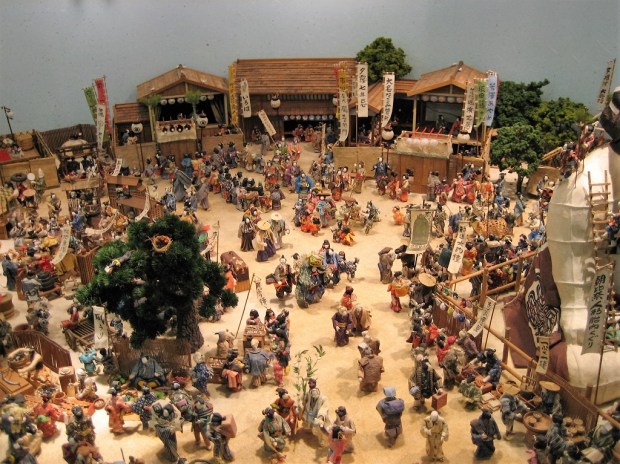
After getting rained out in Nara, my parents and I decided to return to Osaka and find some indoor activities. The first thing that popped into my head was a visit to the Umeda Sky building, yet another thing I had done on my solo trip to Osaka last year. The building features a giant glass elevator, a glass walled escalator, and spectacular views of Osaka. It was still raining, so we didn’t get too much of the city view. We did enjoy some of the cool models they had depicting life in old Osaka.
The Sky Building concluded a full day of walking and sightseeing, so we decided to call it a night and return to the hotel. Getting back would involve a walk to Umeda station, two subway trains, and a search for our hotel. My dad decided that he wasn’t interested in any more walking, so he suggested that we take a taxi. I told him that taxis were expensive in Japan, but he said that he was on vacation and didn’t care, so we left the building and found a nearby taxi stand.
Taxis in Japan are very different from taxis in Canada. Japanese taxis have automatic doors and drivers in uniforms with white gloves. Canadian taxis absolutely do not have either of these things. We got in and I asked the driver to take us to Park Hotel Rinkai.
This was the first time my parents had been in a taxi in Japan, so they were understandably excited. As soon as we started moving my dad started talking to the driver. The driver nervously responded with “Sorry, no English”. I explained to the driver in Japanese that my dad keeps forgetting that not everyone in Japan can speak English. When my dad saw that I was able to communicate with the cab driver, he asked me to translate for him. I fumbled my way through such questions as:
- What kind of car is this?
- Do all taxi drivers wear white gloves?
- In Canada the taxi drivers are mostly immigrants. How about in Japan?
- Is the day shift in Osaka busy?
- Do you like your job?
My dad is a friendly person by nature who loves talking to people, so this is just normal for him. Even though my Japanese had improved immensely since moving to the country two year ago, I had trouble keeping up with the back and forth communication. There were times when my vocabulary wasn’t good enough to either say or understanding something, so I filled in the gaps with some educated guesses. It was a good challenge of my Japanese abilities, but I was mentally exhausted by the time we reached the hotel!
I have nothing but respect for people who can professionally translate a conversation for a living. It’s not easy at all!
March 29, 2006 part 2 – Rampaging Hordes of Deer
Posted by Barniferous in Visitors, Western Japan on August 14, 2016
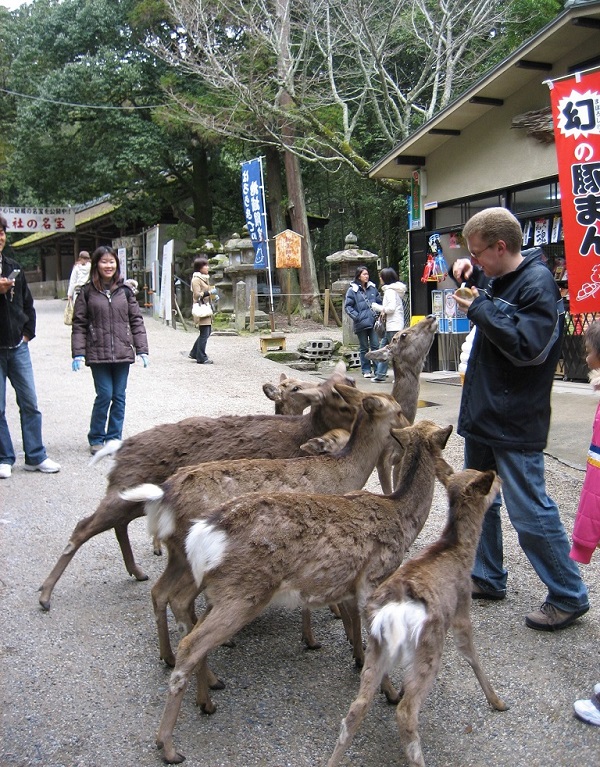
Other than some very old shrines and temples, Nara is famous for the deer in Nara Park. The deer roaming the park are considered sacred by the local shrines, and they are allowed full reign over the park.
The deer are generally tame, and will completely ignore you until you walk up to one of the many vendors in the area and buy deer crackers. As soon as you pay your 150 yen for the small package of crackers, you will instantly find yourself surrounded by hungry, insistent deer who will all gently headbutt you when you aren’t feeding them. As soon as the crackers are gone, the deer will return to ignoring you.
The whole experience is a bit intimidating at first. We did see a few parents laughing after handing a stack of deer crackers to their unsuspecting children, which I personally thought was hilarious!
Because the deer are wild animals, there are some helpful warning signs around the park that remind you of deer safety. Helpful that is, if you can read Japanese.
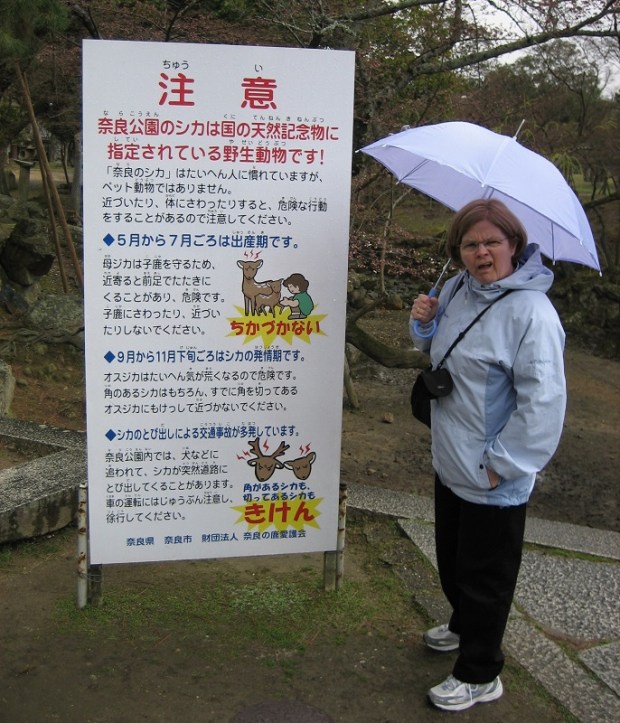
Unhelpful sign is unhelpful
I could read just enough to understand that the deer are not pets, and there are certain times of the year when the deer may be aggressive. I personally don’t need a sign to tell me not to piss off wild animals that are used to getting their own way, but I understand that this may be important for some. Fortunately for me, the worst thing that happened in my interaction with Nara’s deer was getting some deer snot on my jacket.
We would have spent more time in Nara, but the day was cold and it started raining. Since most of the sightseeing places involved walking outside, we decided to head back to Osaka for some indoor exploration.
Feeding the deer in Nara should be on everyone’s western Japan to-do list. It was a really cool experience!
March 29, 2006 part 1 – Very old buildings in Nara
Posted by Barniferous in Visitors, Western Japan on August 13, 2016
Today my parents and I visited Nara, which was another city on my “must see before I leave Japan” list. Nara was the capital of Japan from 710 – 794, and is home to some very old and very impressive buildings from Japan’s past. Conveniently, Nara is just slightly west of Osaka and almost directly south of Kyoto. The greater Tokyo area has lots of fantastic places to visit, but you can’t beat the Osaka / Nara / Kyoto triangle for history.
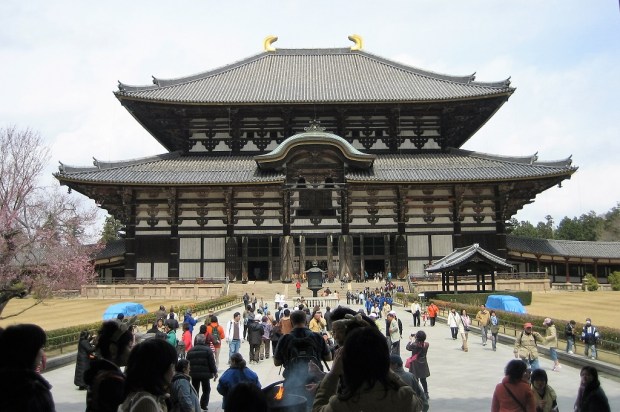
Todaiji is one of the world’s largest wooden buildings, despite the current construction being 30% smaller than the previous version. It was originally finished in 751 AD, and nearly bankrupted the country due to the high cost of construction. The current building dates back to 1709, which is still pretty freaking old by Canadian standards.
When you see Todaiji from a distance it’s hard to get a sense of how immense it truly is, until you focus on how small people look right in front of the entrance. The inside of the building features the largest bronze Buddha statue, along with other very impressive artifacts that you’d find in a 1000+ year old temple.
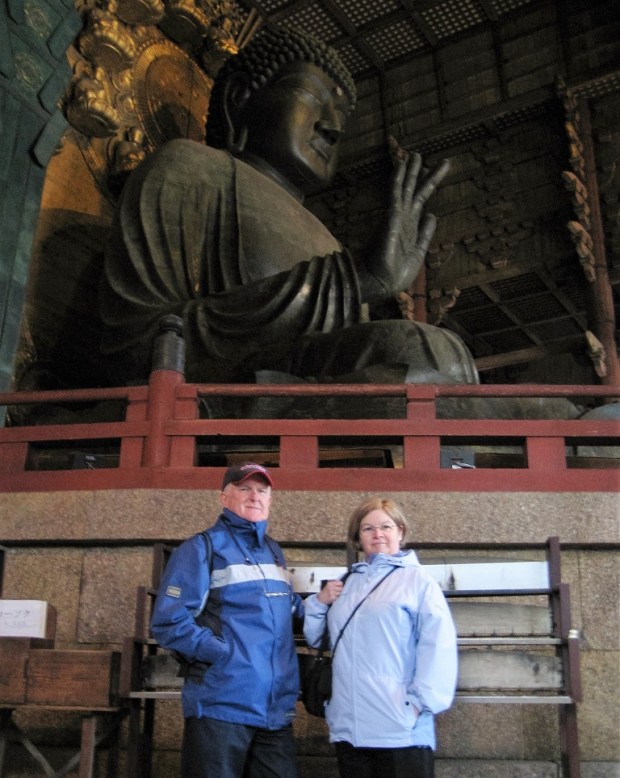
My parents next to the giant bronze Buddha
After Todaiji we visited Kasuga Taisha, Shinto Shrine from the time that Nara was the capital of Japan. The shrine itself was good, but the treasure room inside was really interesting. We happened to be there on the last day of a display of 1000 year old Japanese picture scrolls. We also saw giant ceremonial drums that were over 900 years old.
I always enjoy thinking about the stories behind some of these very old artifacts. How many different people have seen them or touched them over the years? How did they survive wars, fires, storms, earthquakes? For me it’s easier to really connect with something a few hundred years old than millions of years old. We only saw a few of the highlights in Nara, but they were all fascinating for me and I wish I had more time to see everything.
March 28, 2006 part 2 – Osaka Aquarium with my parents
Posted by Barniferous in Western Japan on August 12, 2016
After a morning at Osaka Castle, my parents and I took two trains and less than 20 minutes to get to Osaka Port, home of the amazing Osaka Aquarium. This was another place that I had been on my solo trip west last year, but it was so impressive that I had no problem seeing it again.
Before we went in, we stopped for lunch at the nearby shopping centre. On my last trip I found an okonomiyaki restaurant (one of Osaka’s famous foods) where the staff cook at your table. I tried, unsuccessfully, to describe okonomiyaki to my parents on the train ride. “It’s like an omelette pizza pancake with stuff in it and delicious sauce” wasn’t really enough for them to get a good mental image of the food, so I told them to just trust me. On their first trip to Japan, we probably would have ended up at a McDonalds in this situation. This time we all sat down for delicious okonomiyaki which they loved.
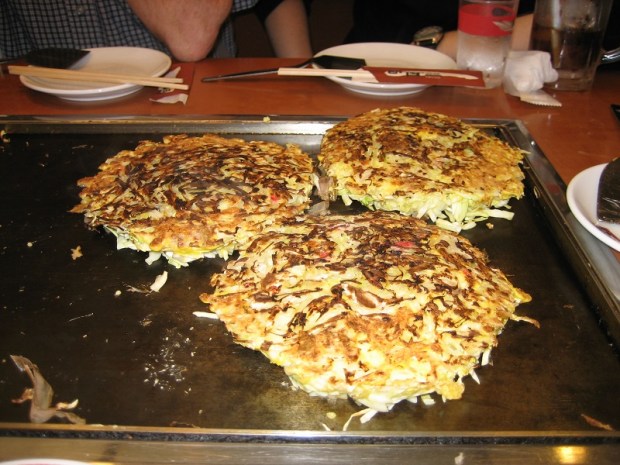
Okonomiyaki ready for sauce. Yum!
The last time I was at the aquarium, I noticed that most of the gaijins at the aquarium were talking about the beautiful assortment of marine life on display, while more than a few of the Japanese people (especially the kids) were commenting on how delicious the assortment of marine life looked. I told this to my parents over lunch, but they didn’t completely believe me. I asked them to listen for the word “oishii” which means delicious. It didn’t take long for them to hear it!
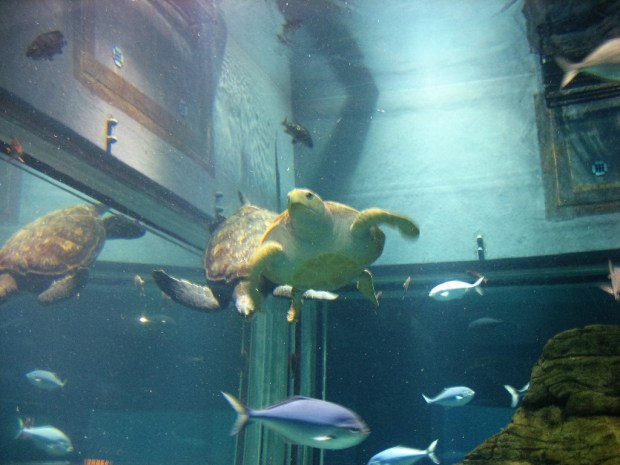
Osaka Aquarium is a world class facility featuring marine life from around the globe. The variety of different species and information available is simply fantastic. I would post more pictures, but it’s extremely difficult to get good pictures through thick aquarium glass. Other than that I would highly recommend the aquarium to all visitors. Also, if you have been in Japan for a while, don’t go hungry – everything will start looking delicious to you.
Before heading back to our hotel, we watched a show at the Imax theatre near the aquarium. It was a fun day exploring Osaka, and we were all ready for an early night! Nara tomorrow!
March 28, 2006 part 1 – Osaka Castle with my parents
Posted by Barniferous in Visitors, Western Japan on August 11, 2016
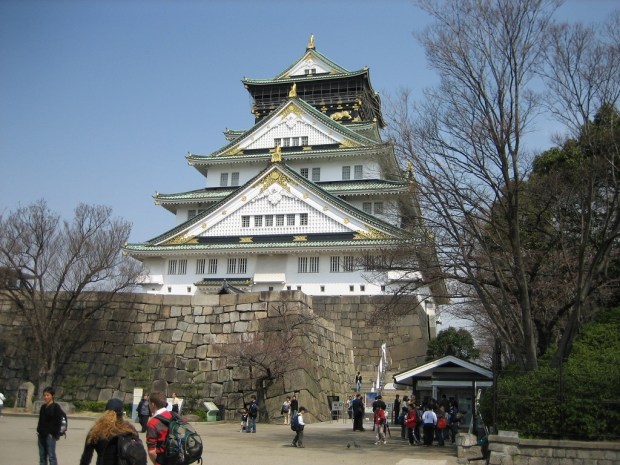
Today my parents and I did some sightseeing in Osaka. We started our day with breakfast at the hotel (with a restaurant full of our new friends), and then headed off for Osaka Castle.
Japan is filled with old castles, and most of them have been destroyed and rebuilt several times. Osaka Castle is no exception; the main tower and surrounding buildings have been destroyed and rebuilt many times over, with the most recent restoration in 1995. After seeing Himeji Castle twice (which was never destroyed), I wasn’t sure that I would enjoy Osaka castle as much. I ended up being pleasantly surprised.
The current version of Osaka Castle is a restored exterior with a modern museum inside. The museum tells the story of both Osaka and Osaka Castle, which was played key roles in the struggle to reunify Japan in the 1500s. The museum was interesting and interactive, and featured excellent English signs.
We explored the castle for a few hours, and then headed towards the obligatory gift shop near the exit. Outside the gift shop is a giant golden tiger and a box full of samurai gear so you can pose for a picture. There were a lot of Japanese people standing around, looking at the tiger and cool samurai clothes, obviously wanting to take a picture, but nobody wanted to be the first person to step up. Fortunately my dad was there to bravely volunteer:
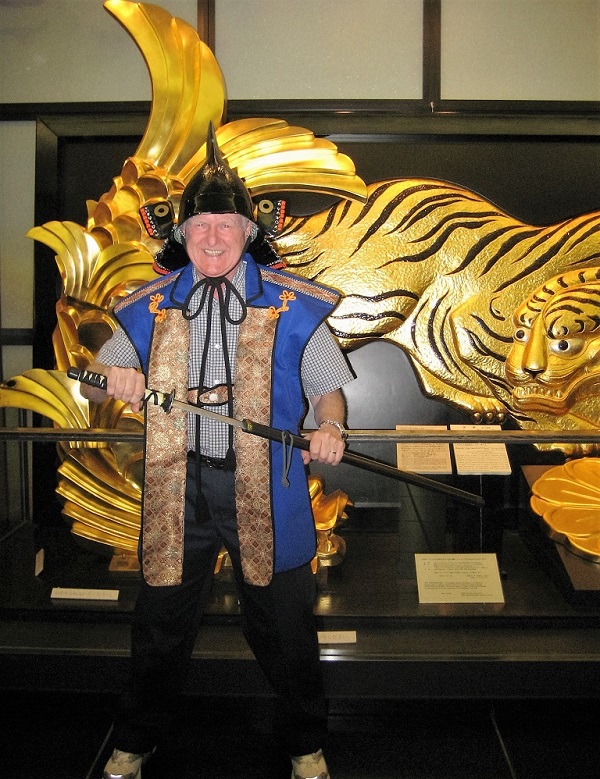
My dad had just traveled half way around the world and was in a modern restoration of a 500 year old castle. I don’t think anything could have stopped him from getting a picture with a fake sword in front of a golden tiger. The crowd of Japanese people, now happy that none of them had to go first, formed an orderly line to dress up and take pictures.
This is exactly the kind of thing that would have embarrassed me when I was a grumpy teenager. However, as a 27 year old I realized that my dad was actually pretty cool, not to mention fun to travel with.
Next up, Osaka Aquarium!
March 27, 2006 part 2 – Middle aged Korean women
Posted by Barniferous in Visitors, Western Japan on August 10, 2016
My parents and I spent our afternoon exploring the magnificent Himeji Castle, and then headed to Osaka to check into our hotel. I had booked us rooms in the Park Hotel Rinkai, an inexpensive business hotel where I had stayed last year. It’s not the fanciest hotel, but it’s centrally located and inexpensive.
Park Hotel Rinkai is easily accessible from two different stations on the Osaka subway. The problem is that I couldn’t remember which exit to use, and we ended up wandering around for some time trying to find our way with street maps, my fuzzy memory, and some good old fashioned guessing.
We did eventually find the hotel, and checked in at the same time as a large group of middle aged Asian women. After checking in, we jammed into a tiny elevator filled with short, chatty women. We were at the back wall of the elevator, so I needed someone to press the buttons for us.
“すみません、10回のブタンを押してください” (Please push the button for 10th floor) I said politely. This got no reaction. Figuring that they might not have heard me over their conversation I repeated myself slightly louder and more clearly. The woman closest to the elevator turned to me and responded in English “Sorry, not Japan, Korea. Korea.”
I responded with the only phrase I know in Korean. “Annyeong haseyo! (Hello) Please push 10”. This got the desired response, and a good laugh from the Korean ladies in the elevator.
I had tried to warn my parents that the hotel rooms were going to be small. I think they were expecting Canada small and not Japan small. They were shocked to see the tiny rooms that I had booked us into. Their room had two single beds (my dad snores like a rusty chainsaw), with barely enough room for their tiny suitcases. My room was so small that the three of us could barely fit inside at the same time, and we are all small people!
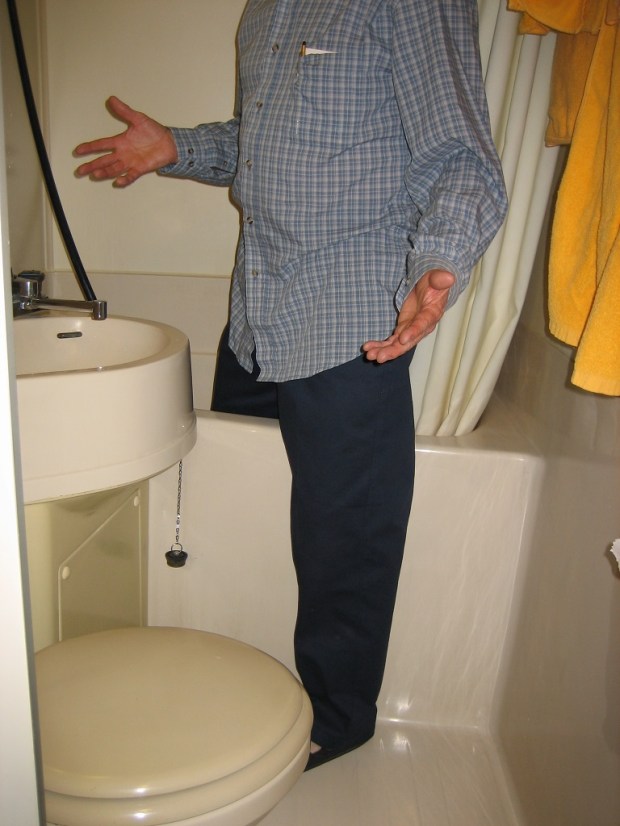
My dad in a business hotel bathroom. He’s only 168cm (5’6″) tall!
I remembered the hotel being fairly quiet the last time, however I didn’t have a tour bus full of excited middle aged women on vacation staying there at the time. Our fellow guests were up late chatting, singing, and generally enjoying themselves. I have now added “middle aged Korean women” to my list of fun people to party with in the future.
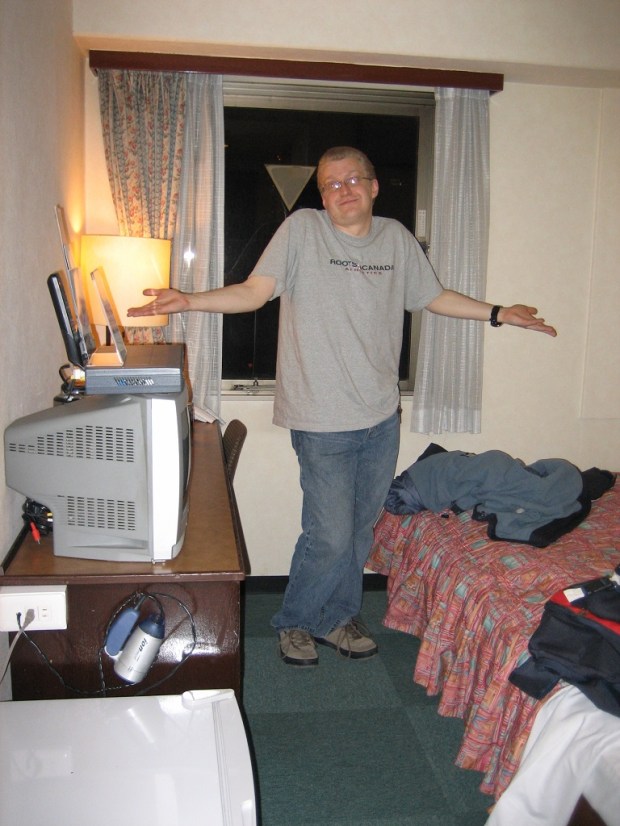
How much hotel room does one person need?
March 27, 2006 part 1 – Himeji Castle (again)
Posted by Barniferous in Visitors, Western Japan on August 9, 2016
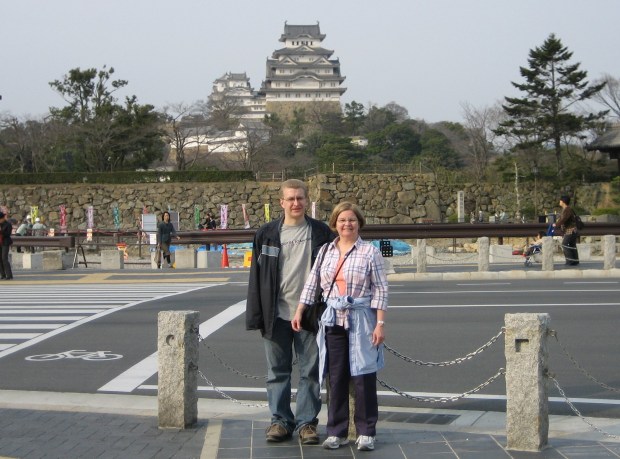
I picked up my parents early in the morning outside Hotel Miwa in Numazu. We were setting off for 4 days of sightseeing in western Japan before returning to Numazu. My parents liked the hotel so much that we booked a room for them when we returned to Numazu. The staff seemed really happy that my parents had enjoyed their stay so much, and not in just a “hooray, repeat business” kind of way. Hotel Miwa is a fantastic place which I would recommend highly!
My parents had learned from their first trip to Japan, and had packed much lighter for their return. The first time they had a bag with a shoulder strap that we referred to as “the green bag of doom” which seemed to weigh about 900kg, as well as some large suitcases. This time they had small bags and backpacks which made for a much more enjoyable experience.
We walked to Numazu station and took Tokaido line to Mishima. While on the shinkansen platform we enjoyed breathtaking views of a snow covered Mt. Fuji before catching the train to Shin-Osaka, with Himeji as our final destination. I don’t travel on the shinkansen often by myself, so I’m always amazed at how quiet and smooth the ride is. We blasted across the countryside at over 250km/h, watching the coastline and cities whiz by the windows.
We arrived at Himeji in time for lunch. While we were standing outside the station deciding where to eat, a friendly Japanese woman approached and asked in English if we were lost. I explained that we were just trying to decide where to eat, and she lept into action, running to the nearby information desk to find out where the station restaurants were located. She apologized sincerely for not being able to recommend one of the restaurants personally.
I have found that Japanese people, especially the ones who can speak English, are almost universally helpful to tourists. They seem to be especially helpful to middle aged tourists like my parents, who have been treated like royalty since landing at Narita.
Unfortunately the restaurant we chose was busy and not nearly as friendly as the nice lady we met outside the station (which is rare), but we still enjoyed a good meal and set out for the castle.
I have been to Himeji castle before, and it is still just as breathtaking the second time. My parents were blown away by the size of the castle, which dominates the view from the station. We spent a few hours exploring the huge castle grounds and the interior of the castle.
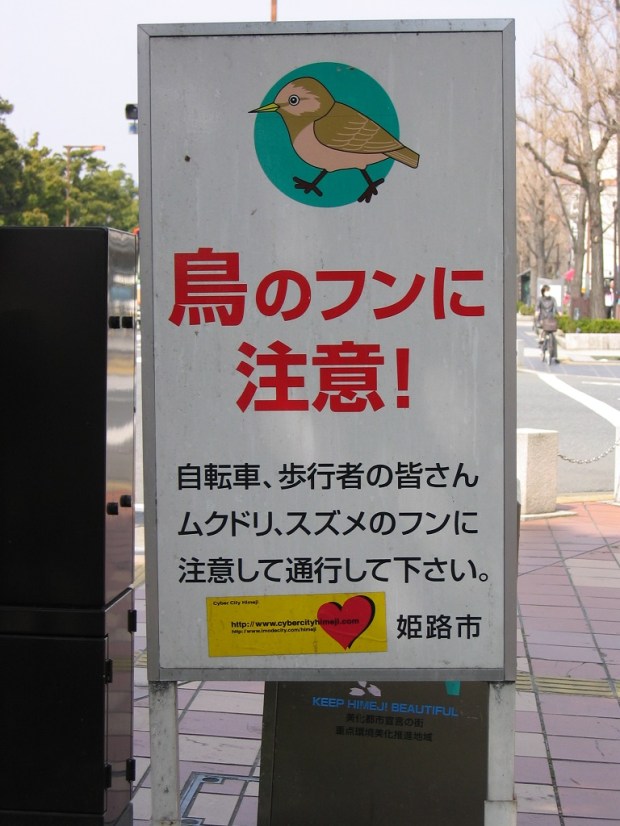
“Beware of bird poop”
I could visit Himeji castle over and over without getting bored; there is just so much to see and enjoy. It was a bit of a letdown to walk away from the beautiful castle towards the station. We boarded the shinkansen again bound for Osaka, which would be our home for the next few days. Good bye Himeji!
January 11, 2006 part 2 – How not to use a sento
Posted by Barniferous in Life in Japan, Tokyo, Visitors on May 13, 2016

Image courtesy of the good folks at Wikipedia
January 10, 2006 part 1 – Respectable sightseeing
Posted by Barniferous in Friends and coworkers, Greater Tokyo Area, Visitors on January 16, 2016
I was confused when my friend UPS woke me up. I was not on my comfortable futon in my room. I was also not on my slightly less comfortable floor couch. I was sleeping on the hard floor in my coworker Vivian’s room, still wearing the same clothes from the day before. UPS wanted to get going before having to engage in any awkward conversations with Chrissy, Vivian’s roommate that he became “acquainted with” the night before.
We walked back towards my apartment, and I was unfortunately not able to get a straight answer on how his night went. We ate, got cleaned up, packed, and took returned to the train station, bound for Kamakura.
At this point in my 2 plus years in Japan, I have been to Kamakura several times, however it never stops being an impressive and interesting place to visit. UPS and I went to see Daibutsu, the giant bronze Buddha statue, and Hase temple. I was able to pass along a lot of the information I had learned from previous visits, and also got an impressive picture with giant Buddha’s sandals!
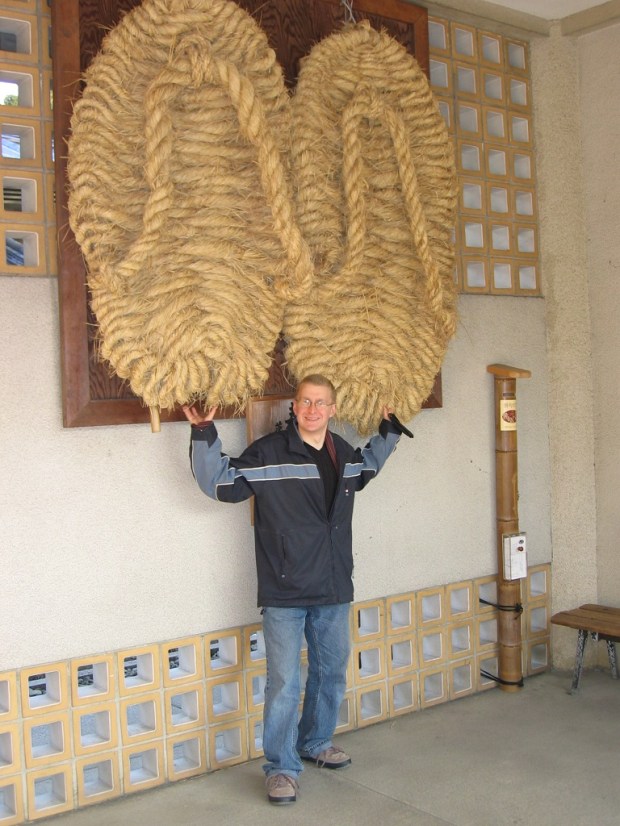
From Kamakura we went to Yokohama, then took Minatomirai line towards the Minatomirai area. We spent a long time wandering around both the port area and Yokohama Chinatown, stopping for some great food. The Chinatown area is very energetic at night, and despite being in Japan, feels like you have wandered into a different country.
After exploring for some time, we decided to continue on to our evening destination: Roppongi.
(cue ominous music)
 Drinking in Japan
Recent Comments