Archive for category Places in Japan
June 30, 2004 – Yokohama
Posted by Barniferous in Visitors, Yokohama on July 20, 2014
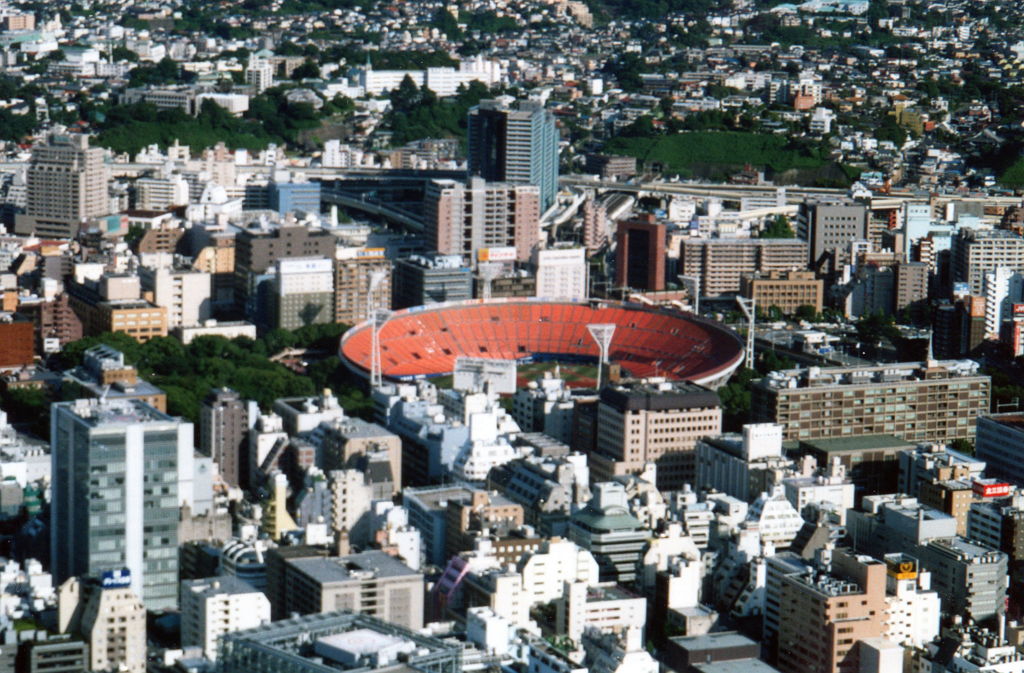
A view of Yokohama from Landmark Tower
Today I took my family to Yokohama. We took the Nanbu line from Noborito to Kawasaki, Tokaido Line from Kawasaki to Yokohama, and then switched to the still shiny new Minatomirai line to finish our trip to Minato Mirai station.
I had been to Yokohama several times before, but this was the first time I had ever gone inside Landmark Tower, Japan’s tallest building. There is an observation level on the 69th floor that is accessable by one of the world’s fastest elevators. The observation level offers amazing views of Yokohama, Kawasaki, Tokyo and on a clear day, Mt. Fuji. The ocean is on one side, and there is continuous city in every other direction as far as you can see. My family was feeling a bit overwhelmed by the neverending city.
From Landmark Tower we wandered around the Minato Mirai area. My mom bought a Hard Rock Cafe t-shirt, and I made sure to show off the dog walking video game at the nearby game center.
After exploring Minato Mirai, we took the train to Yokohama Chinatown. We spent a long time walking around the streets and enjoying the buildings. My mom and sister requested that we stop in a large tea shop. There were different kinds of tea from around the world from floor to ceiling. While my sister tried to communicate with the store owner, the owner’s young daughter (maybe 5 years old) came up to my mom and started talking to her in Chinese. My mom responded in English, so the conversation really didn’t go anywhere. My mom ended up giving the young girl a Canadian flag pin, which got a nice smile and some thanks from the owner.
My family enjoyed their day in Yokohama. Even though I did a very similar visit with my friends a month ago, I still had fun. Yokohama is a great place to visit.
(2014 Update) In 2014 the Abenobashi Terminal Building opened in Osaka, which is about 4 meters taller than Landmark Tower. Landmark Tower is now number two in Japan.
June 29, 2004 – Ueno Park, Homelessness, and Museums
Posted by Barniferous in Tokyo, Visitors on July 20, 2014
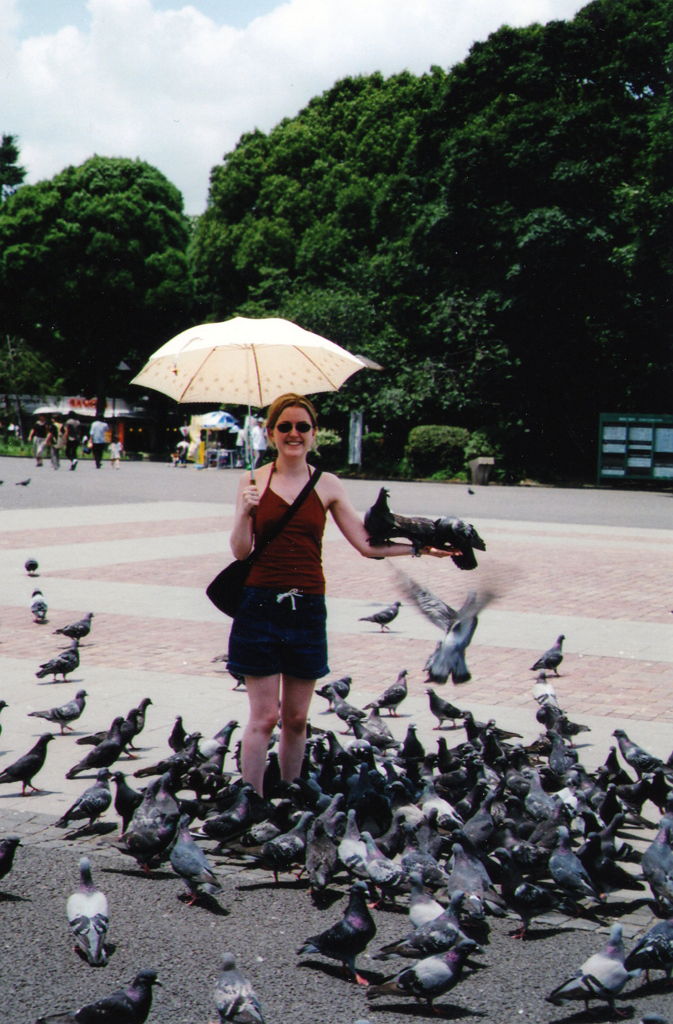
My sister feeding pigeons in Ueno Park
Today I took my visiting family out to Ueno Park. We got moving after breakfast and took the Odakyu line from Noborito to Shinjuku, then the Yamanote line to Ueno station. My family was impressed that all of the trains arrived exactly when they were supposed to. Mass transit in Canada is nowhere near as punctual.
We explored Ueno Park, enjoying the trees, duck pond, and the people. In one of the large open areas there was an older man feeding pigeons. Pigeons are a very common sight in parks and temples in Japan. The man was standing in the middle of hundreds of pigeons, distributing bread crumbs. My sister walked into the middle of the pigeons for a picture. The man approached her and offered her some bread crumbs. The pigeons were so used to being fed that they literally ate right out of my sister’s hand!
After feeding the pigeons, we headed towards the Tokyo National Museum. Just before we got to the museum we saw something that I hadn’t seen before – a huge group of homeless people. A local mission was distributing sandwiches and was also providing free haircuts.
Japan overall is a wealthy and successful country, so many visitors to the country are surprised that there are any homeless people at all. Officially there are about 25,000 homeless people in Japan. You can easily find makeshift shelters built from cardboard boxes and tarps in Ueno Park, Yoyogi Park, and in various areas around Shinjuku. Most of the homeless people are older men.
We continued walking towards the Tokyo National Museum. I had been to the museum with my friends less than a month earlier, but it was still incredibly interesting. I could probably spend a few days in the museum and not get bored. We spent a few hours exploring the extensive Japanese collection, with much of our time devoted to the popular attractions – swords and armor. Like my friend previously, my family tried to take a lot of pictures, and most of them came out blurry.
When we finished with the museum, we started the journey back to Noborito. Since my dad does not like crowds, we got reserved seats on the limited express from Shinjuku to Noborito. This allowed us to have our own seats and avoid all of the usual pushing and shoving. The cost was about 600 yen each, but I think my dad would have paid more to avoid the packed commuter rush.
It was a good day out in Tokyo, and we are looking forward to exploring in Yokohama tomorrow.
(2014 Update) I think it’s interesting that we saw both pigeons and homeless people lined up in Ueno Park looking for some food. People were happy to see the pigeons, but many people were uncomfortable by the presence of the homeless people.
Sanyukai is one of Japan’s largest homeless charities. Check out their English website here. There are other organizations as well, and they are all doing very important work. If you aren’t in Japan, see what you can do in your own community. Shelters and food banks rely on their volunteers to survive. Your donation of time, money, or clothing can make a huge difference to someone who really needs it.
June 27, 2004 – My family arrives in Japan
Posted by Barniferous in Hello House, Tokyo, Visitors on June 27, 2014
A mere 19 days after I dropped off my University friends at Narita airport, I was once again taking the cheap trains to pick up visitors. This time I would be picking up my parents and sister.
My parents would have never considered traveling to Japan if I wasn’t living here. In fact, they have never traveled outside of North America before. My parents are in their mid 50s and live in a small town west of Winnipeg. My father is an air traffic controller – he was in the Canadian Forces for 27 years, retired, and then started doing the same job as a civilian. He is one of the friendliest people I know and has no issues starting a conversation with complete strangers. My mother is a teacher’s assistant at an elementary school. She specializes in helping hearing impaired and deaf students. My sister is a University student who lives in Winnipeg. She is in her early 20s, short, and very smart. However, she will believe almost everything I tell her, a fact that I occasionally abuse for comedic effect.
When I picked up my friends from the airport, I ended up having to wait a long time for them to clear customs and immigration after their flight landed. I had considered arriving about an hour after my family’s flight landed, but was worried that if they somehow got through early, they would be worried that they couldn’t find me. I got to the airport exactly when their flight arrived, and ended up having to wait about 90 minutes for them to show up.
At this point it had been 9 months since I had seen my family. My sister looked mostly the same, but my parents looked older. They all commented on how skinny I looked, since I had probably dropped about 5kg (12lbs) since moving to Japan.
We got tickets for the Narita Express and were on our way to Shinjuku from the airport. Just like my first train ride into Tokyo, and my friends after that, my family was amazed at the size and density of the city. Everyone always gets excited, and then they realize they are only in Chiba and things are only going to get busier.
We made a brief stop in Shinjuku to look at the skyline. The largest city my family had ever been to was Toronto. Tokyo is like stacking a few Torontos on top of each other. I taught them all how to use the train ticket gates, and we headed off for Noborito.
I couldn’t get the same guest room in Hello House East that my friends had, however I got a bigger, nicer room in Hello House West for my parents. They were impressed with the room (and the price), but were a little concerned about sleeping on futons on the floor. My sister was going to stay in my room on my futon, and I would sleep on my foldy floor couch. After giving them all of the key information on Hello House (where the bathrooms and coin operated showers were located), we decided to head out and get some food.
My dad can be pretty adventurous with food, but my mom and sister aren’t as much. To ease them into their Japan experience, we ate at a Spaghetti restaurant near Mukogaokayuen station. We walked from Hello House, and my family enjoyed looking at all of the different businesses along the way. Everyone ordered fairly non-threatening spaghetti (no squid ink sauce for anyone), and we had our first meal as a family in 9 months.
I really missed my family and was happy they came to visit me! It’s going to be a great few weeks!
(2014 update) My dad told me later that he had brought two apples to eat on the plane. He finished one, and kept the other in his carry on luggage. When the customs staff asked if he was carrying any fruits or vegetables, he pulled out the apple. The customs staff told him that he would have to dispose of the apple before he could enter the arrivals lounge. He considered arguing or eating the apple in front of the customs staff, but instead tossed the apple in a nearby garbage bin.
June 6, 2004 pt1 – Kamakura in the Rain
Posted by Barniferous in Greater Tokyo Area, Karaoke, Team Awesome Sauce, The Penpal on June 18, 2014
A rainy day in Kamakura.
Today was the last full day in Japan for my visitors. Breaking with our trend, we all actually got up early. The plan for the day was to meet The Penpal and her friends in Kamakura and see some of the sights. It was raining steadily as we left Hello House for the station.
We met up with The Penpal and friends, and got a quick lunch before sightseeing. During lunch, Flounder was trying to teach some rude English to the Japanese people in our group. He was trying to convince them that “motherf**ker” was a commonly used word between friends, and provided various examples. I think Flounder believes that we all live in a 70’s blaxploitation film.
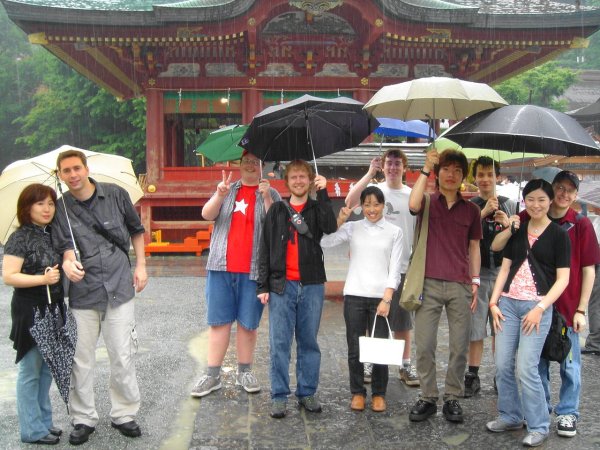
After lunch we started our sightseeing at Hachiman-gu shrine. Despite the rain we saw yet another traditional wedding. From Hachiman-gu we walked to Daibutsu. By this point the rain was bucketing down and we were all soaked, even with umbrellas. Almost nobody carries an umbrella in Winnipeg, so Code Red, Hippie, Green and Flounder were all having umbrella fights as we walked.
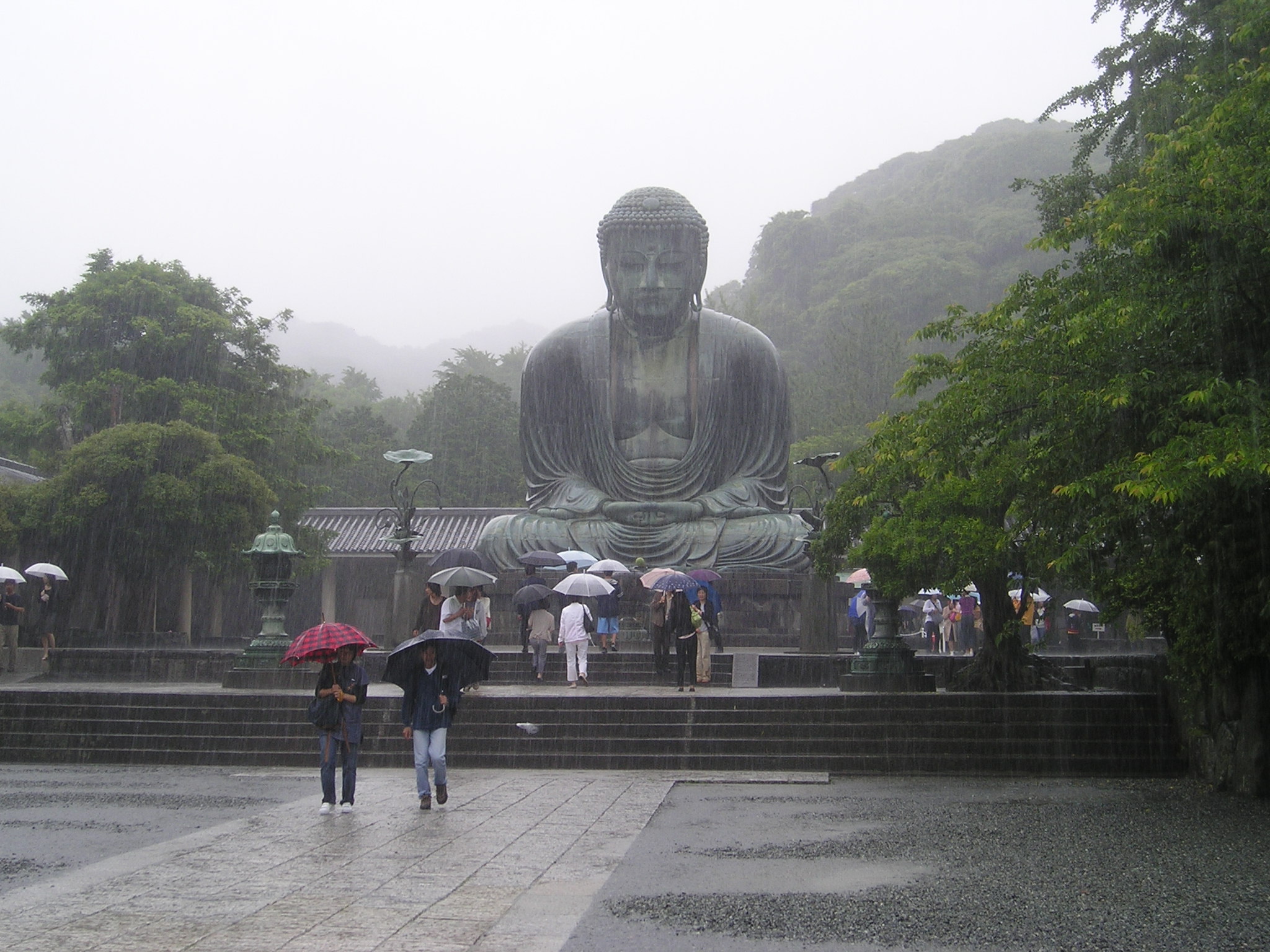
The giant bronze Buddha of Kamakura
At Daibutsu we spent most of our time under cover trying to stay out of the rain. Since the rain didn’t let up, we decided to go back towards the station and find an indoor activity to do. We went to – you guess it – another game center. The game center had a large selection of print club machines. Print club machines are large photo booths that are popular with teenage girls. You can take your pictures with various backgrounds and then draw on the pictures or add cute pictures. At the end the machine prints out copies of your pictures. We loaded all 8 guys in our group into the print club machine and took some ridiculous pictures. After the game center, we found some nearby karaoke where we sang and ate.
We returned to Hello House soaked to the bone after a fun day. Going to Kamakura is always good, but today was was even more exciting because I got to introduce my girlfriend to my friends.
June 5, 2004 – The Strip Club
Posted by Barniferous in Kawasaki Nova, Teaching English, Team Awesome Sauce, Tokyo on June 17, 2014
I had to work today, leaving my visitors to their own devices. At work I had a one on one class with a kid known around Kawasaki NOVA as “Notorious”. I expected the worst and was pleasantly surprised.
When I returned home, I found the guys drunk and grumpy from a bad experience in Kabukicho during the day. Apparently they went out to see strippers. In the strip club they ended up having some drinks and singing karaoke with one of the dancers. When it came time to settle up the bill, there were charges for singing with the dancer on the bill. Some of the guys didn’t want to pay, as they were not told in advance that there would be any charge. To avoid an argument with the establishment, Flounder settled the bill and then tried to get the rest of the group to pay him back.
The money was the main reason why everyone was grumpy, however we were all at the point in our vacation where we had been spending entirely too much time together. Being with the same people 24 hours a day for two weeks is a whole lot of togetherness.
In the evening, Code Red and Hippie stayed at Hello House, while Flounder, Blue and I went out with Lux and some of the other Hello House residents to a nearby izakaya for beer and grilled mochi.
(2014 Update) I have heard a few different versions of what caused the money dispute at the strip club, but this version seems plausible. Since I was at work and all of the participants were drunk, it’s possible that I will never know for sure. Not surprisingly, there are no pictures from that day!
June 4, 2004 – It’s like leapfrog, but nobody’s jumping
Posted by Barniferous in Shenanigans, Team Awesome Sauce, Tokyo on June 16, 2014
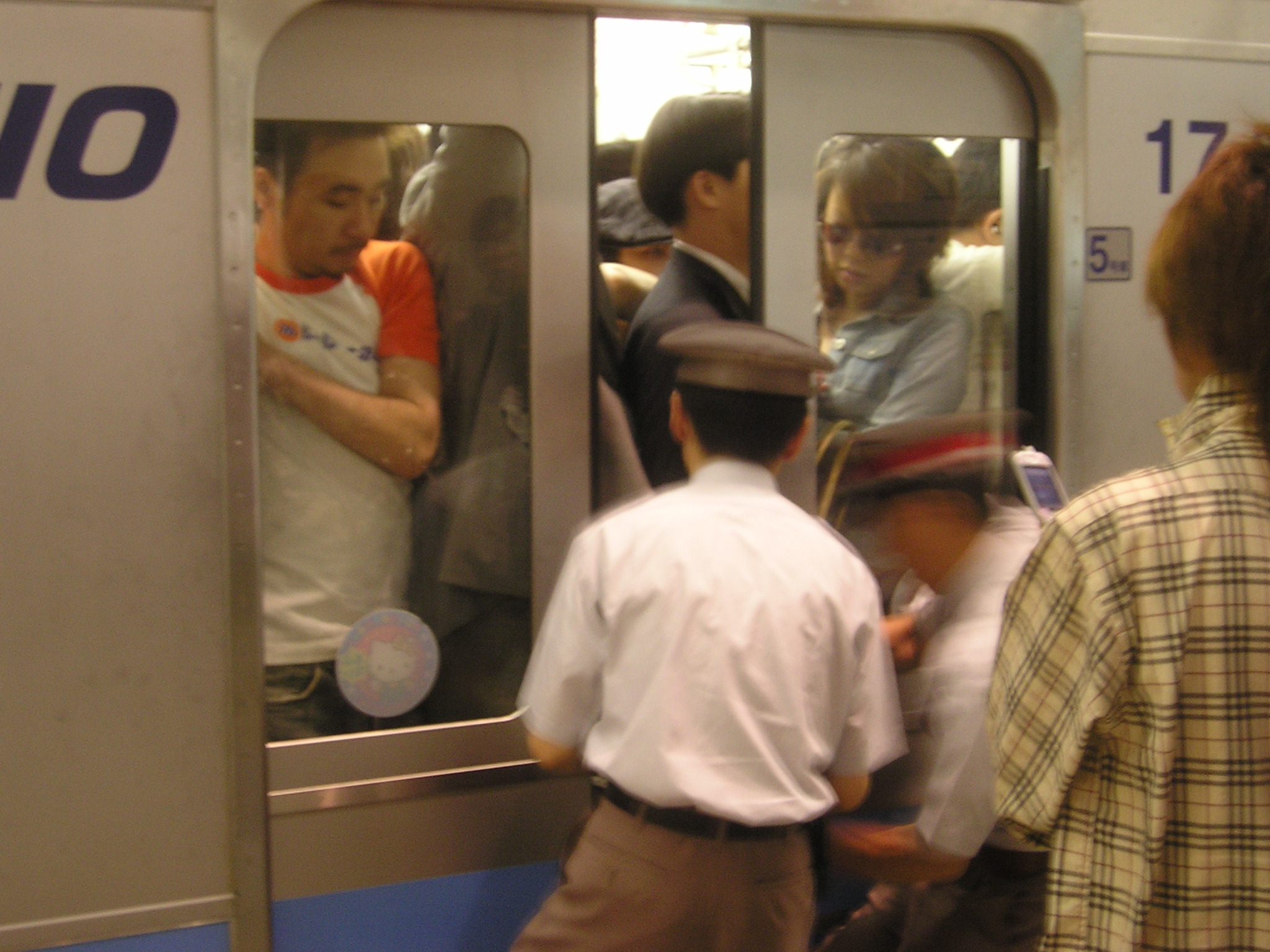
Pushing people onto the Keio line at Shibuya Station
I had to work today. The guys went to a sword museum in Tokyo, and then met up with me outside Kawasaki station at the end of my shift. They all requested another night out in Shibuya. We spent our time in game centers and then went back to Don Quijote, this time sober enough to fully enjoy the experience. Green and I both bought small beer chilling machines which claim to cool a beer from room temperature to drinking temperature in 90 seconds. For the price of 2000 yen this seemed like a reasonable gamble.
We got to Shibuya station a bit early to avoid any chance of missing the last train. Our route home was the always crowded Keio line to Shimokitazawa, and then Odakyu line to Noborito. When we got to the platform we saw the second last train loading up. It was literally wall to wall people. This gave us a chance to see Japan’s famous train pushers for the first time. They are railway staff that push all of the arms and legs into a crowded train car so the doors can close. If you want a true Japan cultural experience, you have to see the train pushers in action.
We went to the front of the line and waited for the last train of the evening to arrive. We were in the last train car standing against the back wall of the car in a row. I regretted my purchase of the beer cooling cube as I had to awkwardly straddle it while the train car filled up. By the time the train was ready to leave, the train car was packed like sardines and we were pressed up against the back wall. Due to my awkward straddling position, a nearby drunk man tried to use me as a seat.
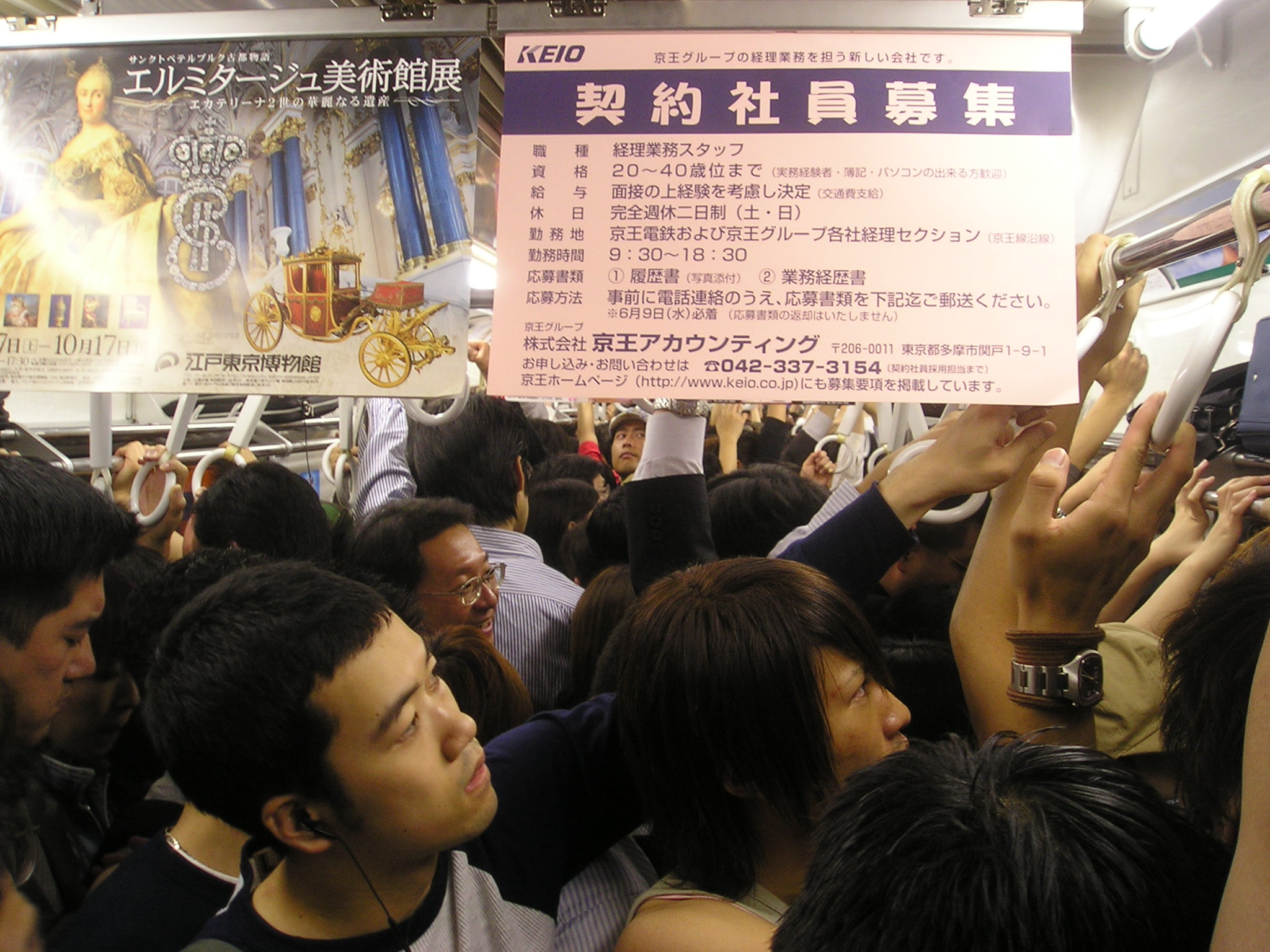
The view inside the last train out of Shibuya
As we got moving, a drunk woman crawled between Flounder’s legs and started looking like she was going to be sick. Flounder described the situation to me as “It’s like a game of leapfrog, but nobody’s jumping!”. Everyone in the area who could understand language was laughing at the situation.
When we got closer to Shimokitazawa station, I instructed the guys that we had to get off the train quickly and run to Odakyu line. I let them know that we only had a few minutes to make our connection before the Odakyu line left. I made very clear to them that if they didn’t get off the train before the doors closed, that they would have no way of getting back to Hello House.
At Shimokitazawa the doors opened and a crowd of people started flowing out of the train. Japan is a usually very polite and orderly country, except on crowded trains. When the train is crowded, anything goes. Hippie, Code Red, Green and I all forced our way off the train, but Flounder was trapped behind a man who stood directly in the doorway with his arms crossed.
Flounder yelled out “I can’t get off the train!”. I replied “you HAVE to get off the train NOW”.
Flounder, hearing the urgency in my voice, decided that desperate times called for desperate measures. He tried to go left – not enough space. He tried to go right – too crowded. He then grabbed the door blocker by his elbows, picked him up, and carried him off the train.
The door blocking man was furious at being picked up like a toy and moved out of the way. He turned around angrily and found himself staring directly into the middle of Flounder’s chest. As he slowly looked up at the giant smiling gaijin, he decided that he wasn’t all that angry anymore and quickly got on the train without a word. The nearby people on the platform thought this was hilarious. Flounder simply shrugged and told me “you said I had to get off the train now”. We all continued laughing as we ran for the Odakyu line to catch the last train back to Hello House.
Description on the beer cooling machine:
Drinking a glass of beer helps yourself release fatigue and mental stress after you come back home. Just pull down the lever and get a chilled canned beer for your relaxing time. COOLING CUBE creates a healing time and space beyond reality for you. Since 2002.
June 1, 2004 pt2 – I don’t understand medal games
Posted by Barniferous in Greater Tokyo Area, Life in Japan, Team Awesome Sauce on June 11, 2014
After dinner, we all went to Kawasaki. I needed to get some shift swap paperwork signed, so I left Code Red, Hippie, Flounder and Green at a nearby game center. Since I was in casual clothes, I couldn’t go into the building to meet the other teachers, so I hung around in front of the building waiting for them to come out. Japan is a very safe country, but there are always a bunch of homeless people hanging around in the trees near the entrance to NOVA, so it’s not the most comfortable place to hang around.
Eventually the teachers came out and I got my paperwork signed. I walked to the game center to find everyone watching Flounder playing a large medal game. The game had bouncing balls, flashing lights, video screens, and a coin pusher, basically total sensory overload. Flounder was trying to manipulate the coins in order to push more tokens towards his collector. There were a number of other medal games in the area – horse racing simulators, slot machines, card battle games, and others.
Using gambling machines to win money is illegal in Japan, but you can win prizes. One popular example is pachinko, which is kind of like a high tech vertical pinball game. To play, you buy a bunch of little metal balls and feed them into the pachinko machine. Using a knob, you attempt to fire the balls through the game board into a small hole. Doing this wins you more little metal balls. When you are done playing, you can exchange any balls you have left for a prize. The loophole is that every pachinko parlour in Japan has a nearby prize exchange shop, where you can sell your prize for cash.
I was not familiar with medal games, but I assumed that they would operate on the same principle as pachinko. Flounder won a huge number of tokens playing the game. He took them to the service counter, where the tokens were counted and Flounder received a card that kept track of how many tokens he owned. The next time he returned, he could use his tokens again to play the games and attempt to win more tokens. I tried to ask the employee where the prize exchange was. The employee tried to tell me that there was no such thing for medal games. At the time I wasn’t sure if he was telling the truth, or just not allowed to explain about exchanging prizes for cash. I promised Flounder that I would look into it.
Medal games can be a fun way to spend some time, but there is no way to win money. If you want to try to gamble for cash, play pachinko instead.
June 1, 2004 pt1 – Mexican pandas and fighting monkeys
Posted by Barniferous in Team Awesome Sauce, Tokyo on June 10, 2014
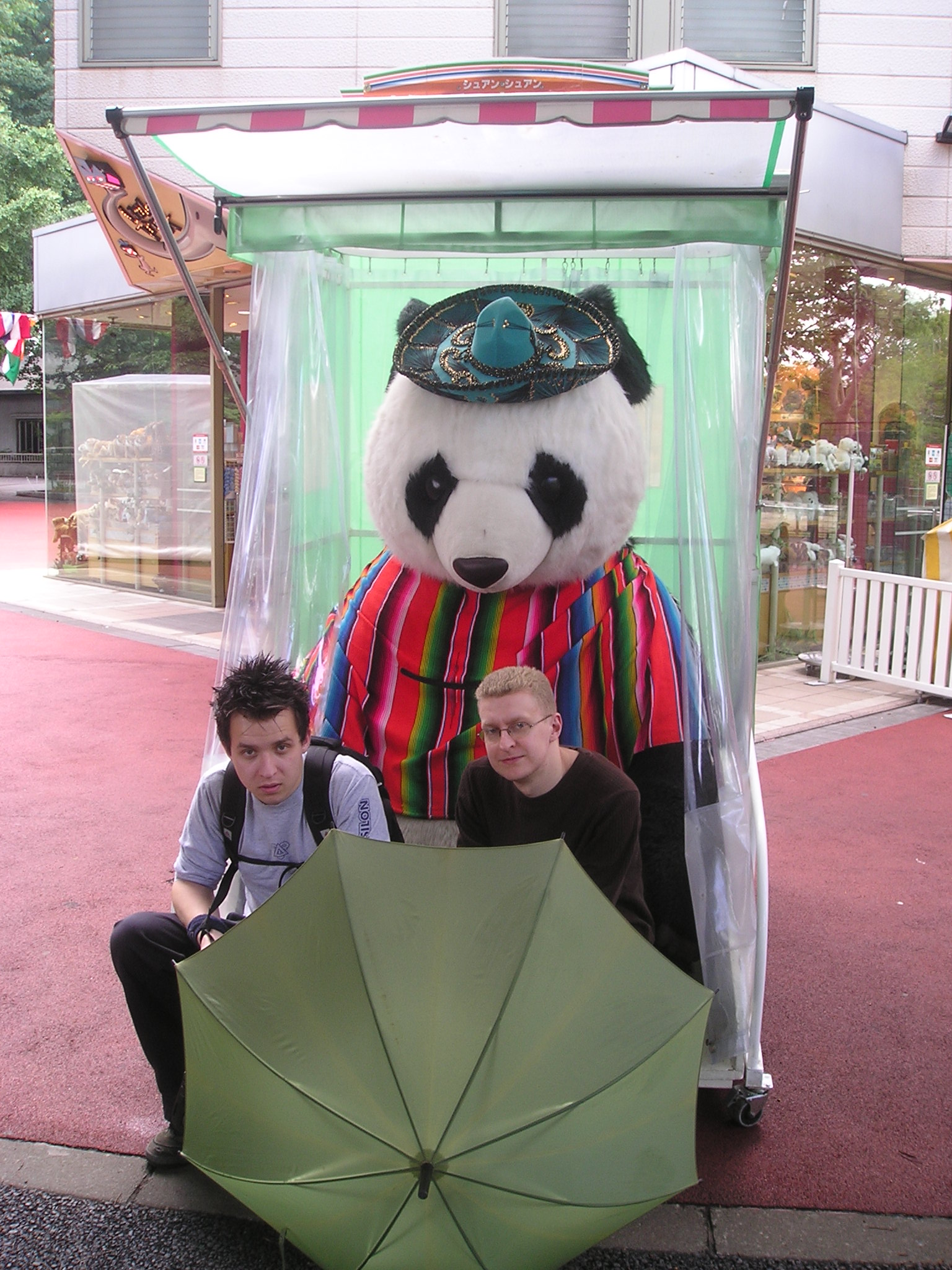
Code Red and I in front of a Mexican Panda
Our group slept in again, likely as a result of our previous night’s karaoke outing. When we finally got moving, we went to Ueno to check out a museum, the park, and the zoo.
Our first stop was Tokyo National Museum, which is located in Ueno Park. The museum is massive, with collections from Japan and other parts of Asia. We stayed in Honkan, the Japanese gallery. I took a Japanese history class in University, so everything in the museum was fascinating for me. I could have probably spent an entire day looking at all of the pieces from Japan’s long history and reading each and every single one of the displays. The other guys, having never taken any courses in Japanese history, were mainly interested in the swords and armor. After taking what seemed like hundreds of blurry pictures of swords and armor (due to glass cases and lighting), they dragged me out of the museum and on to our next destination.
The next stop was Ueno Zoo, also located in Ueno Park. Ueno Zoo opened in 1882, making it Japan’s oldest zoo. It currently has around 2600 animals from around the world. Since the five of us are from Canada, we were used to seeing huge zoos with massive animal habitats. The Ueno Zoo was a very nice zoo, but the animal habitats were much smaller than what we would expect to see back home.
We were pretty confused when we started seeing panda statues wearing sombreros and ponchos all over the zoo. None of us have been to China, be we know that pandas are not commonly associated with sombreros. It turns out that Ueno Zoo was borrowing Shuan Shuan the giant panda from a zoo in Mexico during the time of our visit. It’s always cool to see pandas live!
Other than the panda, the highlight was the monkey enclosure. We watched for at least 10-15 minutes while two monkeys were fighting. The fighting wasn’t life or death fighting, but more along the lines of WWE style play fighting. I would be happy to go to a zoo that just had monkeys, because they are always entertaining. The one lowlight for us was the polar bear enclosure. We saw two skinny polar bears walking around, definitely not enjoying the heat. I think we would have all liked to see an indoor, climate controlled area for the polar bears.
We stayed until the zoo closed, and then went to Roppongi Hills. The movie theater at Roppongi Hills occasionally has current Japanese movies with English subtitles. We wanted to see the new live action Cutie Honey movie, but the schedule didn’t work out in our favour. We ended the first half of our June 1 adventure at Saizeriya.
Travel tip: when you have a group of people that all like different food, find a family restaurant like Saizeriya or Gusto. The food is reasonably priced and there is something on the menu for everybody.
May 31, 2004 pt2 – Games and porn?
Posted by Barniferous in Team Awesome Sauce, Tokyo on June 9, 2014

Akihabara!
After spending a few hours in Asakusa, Team Awesome Sauce and I went to see Akihabara, the famous electronics district of Tokyo and centre of geek culture in Japan. None of us had ever been there before, but we expected to find lots of electronics stores, duty free shops, video games and anime models.
Akihabara is served by several JR lines as well as the Tokyo Metro. Since we were coming from Asakusa, we were on Tokyo metro. Subway stations in Tokyo are huge and can sprawl under several city blocks. If you don’t know which exit you need to take, you can end up a long way from your destination. That’s exactly what happened to us.
We came out of the subway in an area that didn’t have any of the brightly coloured stores that we were expecting. We wandered around for a few blocks while I took some abuse over not knowing where I was going. Eventually we found a movie and book store. Most stores in Akihabara are in tall narrow buildings, with different things on each floor. The first and second floor of the building had lots of cool looking movies. The third floor had porn. Lots of porn. The fourth floor was also entirely filled with porn, but not your typical, every day, conventional porn. There were several things that I will choose not to describe here. Let’s just say that you should love your pets, but you shouldn’t LOVE your pets. Japan has some strange obscenity laws that allows porn to contain all kinds of things that would be considered illegal in other countries, as long as the genitals are blurred out. After escaping the fourth floor we found that the fifth floor also contained porn, this time discount porn of a more conventional variety.
We left the store and eventually found that the electronics shops were conveniently located around JR Akihabara station. If we had taken JR instead of Tokyo metro we would have found them easily. I lost track of how many electronics and games stores we went into. Most of the electronics stores sold both Japanese models and export models of their goods. All of the game and toy stores had porn.
Akihabara is a really cool place to explore if you are into anime, video games, or electronics. You should never bring kids to Akihabara. Ever.
(2014 update) It’s amazing how much Akihabara has changed in the past 10 years. In 2005 the Yodobashi camera mega store opened in Akihabara, giving the other electronic chains some serious competition. In addition to game and electronics stores, the streets are now loaded with maid cafes. The area is always busy and crowded. Also, the porn is still everywhere.
So. Much. Porn.
May 31, 2004 pt1 – Banks and temples
Posted by Barniferous in Team Awesome Sauce, Tokyo on June 8, 2014
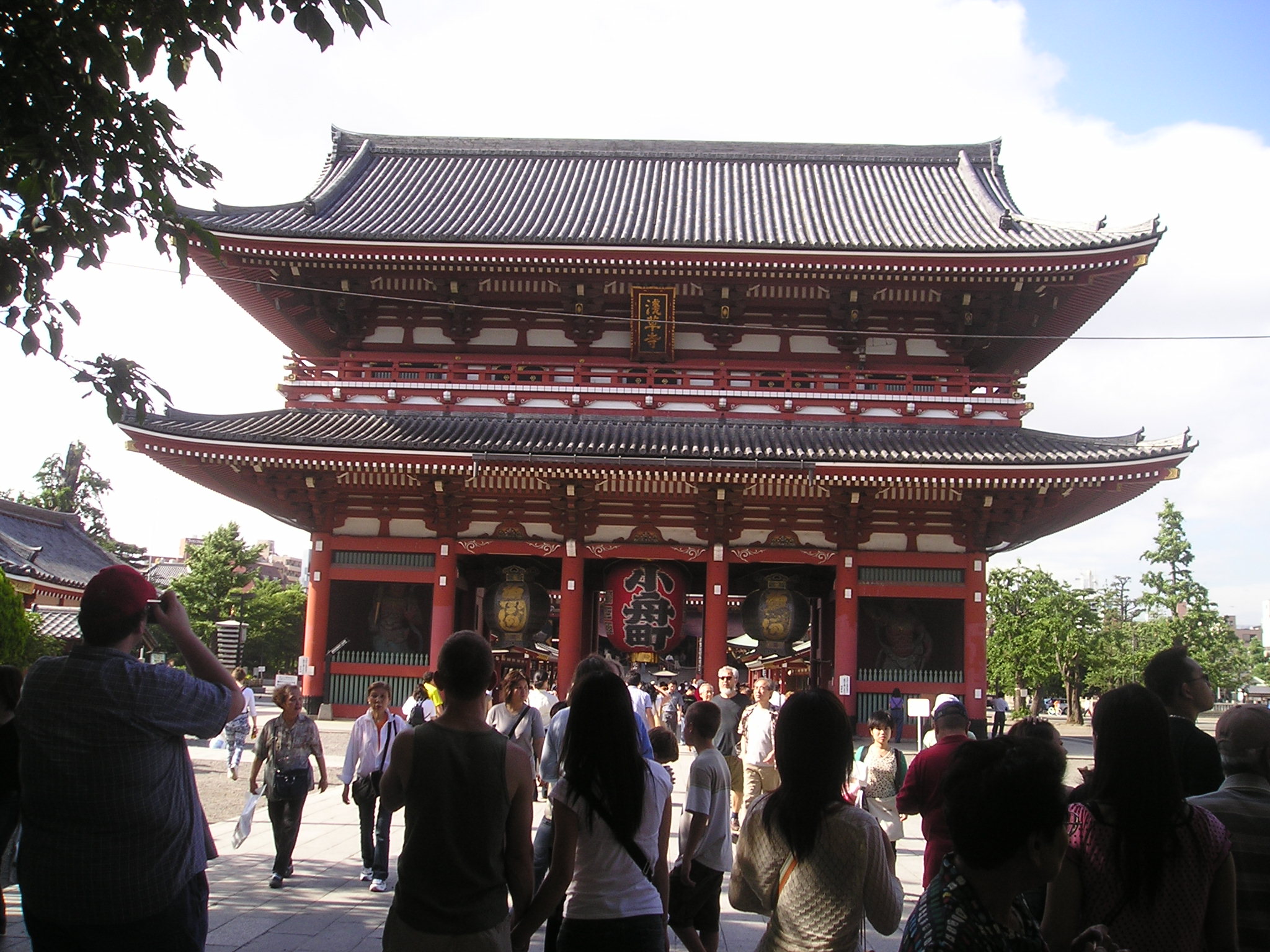
Senso-ji
The guys brought a lot of their money to Japan in Canadian traveler’s cheques. After a week of adventure, they needed to get more cash.
After breakfast we went to a nearby bank in Noborito with an English sign stating that they exchange traveler’s cheques. However, when we went into the bank, they explained that they would not accept Canadian traveler’s cheques without the original purchase agreement. They also would not exchange Canadian cash into Japanese yen. We realized that we would need to find a bigger bank, so we went to Shinjuku where we easily exchanged the money and got service in English.
Flush with cash, we headed off to Asakusa to see Senso-ji temple, the oldest and most famous Buddhist temple in Tokyo. Senso-ji was originally founded in 628 AD and has gone through many upgrades and changes over the years. During World War II it was destroyed in the American air raids. After the war the temple was rebuilt as a symbol of rebirth.
The temple is famous for its large gates and lanterns, but for me and my friends the highlight was Nakamise – the 250 meters of stores leading from the gate to the temple. Nakamise is one of the best places to shop for souvenirs. We navigated the crowds and everyone bought some proper souvenirs to take home. Code Red wanted to bring back a sword, but we weren’t sure if it would be confiscated by customs or not. After much discussion, he decided not to take the risk.
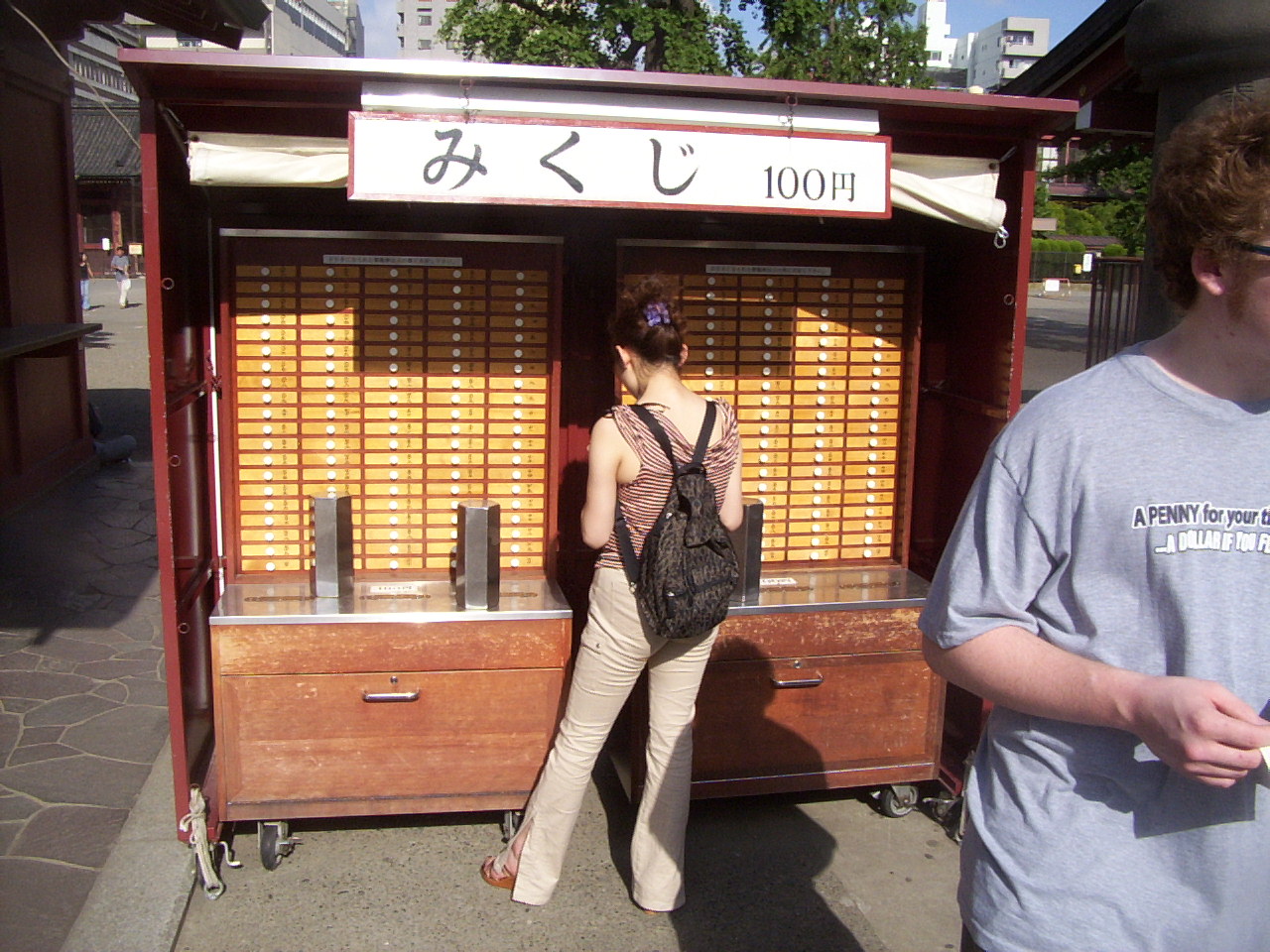
Mikuji stand at Senso-ji
At the temple, I played tour guide, repeating information that I had learned on my travels with The Penpal. I explained how to wave the incense smoke to cleanse yourself before going into the temple. I also explained omikuji – the small paper fortunes that you can buy outside most temples and shrines.
To get your fortune at Senso-ji you pay 100 yen, and then pick up and shake a large metal box filled with sticks. This makes an impressive noise. Eventually one of the sticks will pop out the hole in the top. The stick will have a number written on it – usually in kanji. You then open the drawer with the matching number and take your fortune.
The fortunes will range from excellent to terrible, giving detail on finances, romance, work, etc. If you get a good fortune you can keep it, but a bad fortune should be folded up and tied to a nearby stand. That way you can leave your bad luck behind. Green got the worst possible fortune, but instead of leaving it behind, he insisted on bringing it with him as a souvenir. For the rest of the day Flounder, Code Red, and Hippie debated whether or not they wanted to get on a flight back to Canada with Green if he kept his terrible fortune.
Senso-ji is a must visit if you are in Tokyo. Wear comfortable shoes and be prepared for crowds, and bring a camera because everything is worthy of a picture.
(2014 Update) Does anyone still use traveler’s cheques? Those things are the worst.
 Drinking in Japan
Recent Comments