Archive for 2014
July 2, 2004 pt3 – Where is the f**king hotel?
Posted by Barniferous in Visitors, Western Japan on July 24, 2014
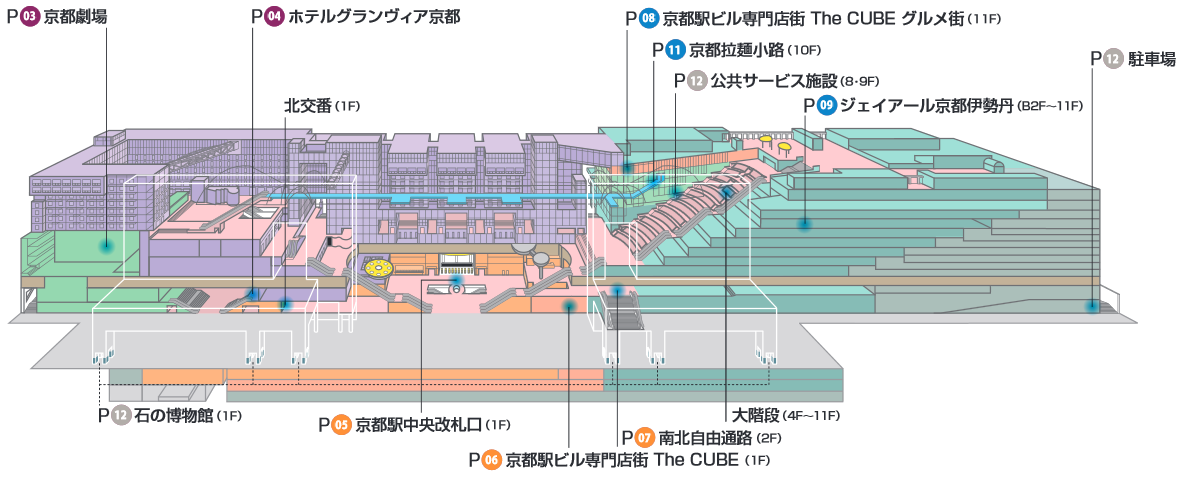
My family and I started July 2 in Kawasaki, then traveled to Hiroshima and visited the Peace Memorial Park. The third and final stage of our long day of travel was returning to Kyoto and checking into a hotel.
From Hiroshima we took the shinkansen to Kyoto station. Yesterday I made an online reservation at the Dai-Ni Tower Hotel in Kyoto, which was described as “just in front of JR Kyoto station”. The only problem was that Kyoto station is HUGE. The station itself is Japan’s second largest station building. In addition to having train service on JR, private train companies, and Kyoto subway, the station also features a shopping mall, movie theatre, and government services. If you need to do anything other than sightseeing in Kyoto, chances are good that you can find it at Kyoto station.
We got off the train with our bags, and then tried to find an area map. The station was so huge that the map was not helpful at all. I decided it was time to test out my Japanese ability and ask for directions. I found a nearby station information booth, approached it and asked the friendly attendant how to find the Dai-Ni Tower hotel.
Asking “where is blabla” is one of the first things people learn in a new language. In Japanese, it is very simple: “blabla wa doko desu ka?”, where blabla is the person, place, or thing you wish to know the location of. The difficult part is understanding the answer.
The helpful attendant looked relieved that I could speak some Japanese, and then proceeded to give me 5 minutes of detailed instructions at high speed. I got him to repeat the instructions, and tried to follow along with language and hand gestures. The directions were as follows:
- Walk to the end of the station
- Turn left
- Walk half way through a bunch of restaurants and stores
- Turn left
- Walk half way down another long hallway
- Go down some stairs
- Walk underground for a while, taking a slight right
- Go up some stairs
- ????
- There’s the hotel
We did pretty well following the instructions until the last part. We left the underground area at the wrong exit, and ended up at the back of Kyoto station with no Dai-Ni Tower hotel in sight. After unsuccessfully trying to find an area map, I got my family to wait nearby with the luggage while I tried to find someone else to get directions from. After a search, I ended up learning that the hotel was very close to where my family was sitting.
I returned to find my sister in a hilarious conversation with some drunk businessmen. They were trying (very poorly) to flirt with her in English by talking about how her gaijin nose was so nice and their Japanese noses were very flat. She declined an offer to go for a drink, and we were on our way.
At the hotel we learned that the online reservation didn’t work, but the hotel quickly found us rooms at the online rate using excellent English. We got our room keys and rode a tiny elevator up to our rooms.
I can’t speak for people from other parts of the world, but North Americans are always shocked by the size of Japanese hotel rooms. My parents had their own room, and my sister and I shared a room. If we could have knocked out the wall between the two rooms it would have been about the size of a typical Canadian hotel room. It was small, but at least we found the f**king hotel.
(2014 Update) Despite our difficulty in finding it, I would recommend the Dai-Ni Tower Hotel. It is located close to the station, is clean, quiet, and reasonably priced. Look it up on your favourite map website first, or make good use of any mobile device with GPS. Also, travel light: the only thing less fun than being lost is being lost while transporting large bags. Travel light!
July 2, 2004 pt2 – Hiroshima Peace Memorial Park
Posted by Barniferous in Visitors, Western Japan on July 23, 2014
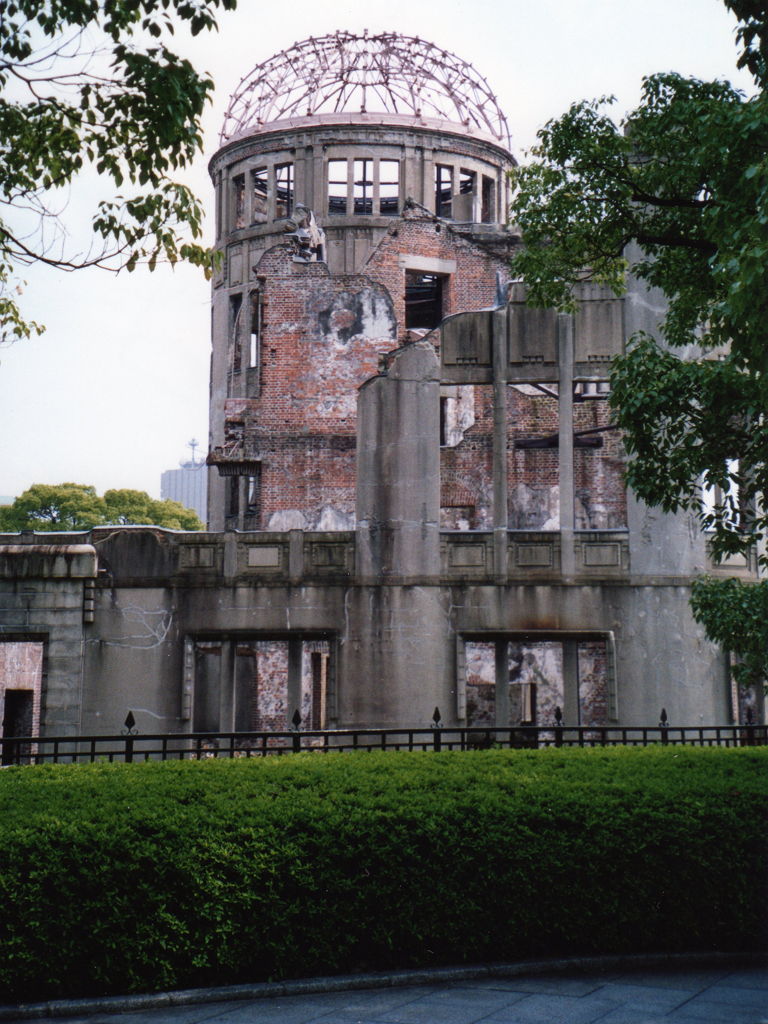
After spending the morning traveling from Kawasaki to Hiroshima at high speed, my family and I were looking for some food. It’s always a safe bet to find inexpensive and quick food at major train stations. We quickly found a small restaurant with a display of plastic food outside that looked good. When we went inside, the menus were all text with no pictures. Most of the characters were beyond my Japanese ability. The nice waitress, likely familiar with foreign tourists, took us outside the restaurant to look at the food models so we could order.
When it was my turn to order, I told the waitress in Japanese that I would like the una-don, which is grilled eel on rice. Not sure if I knew what I was ordering, the waitress responded with “unagi wa… eigo de… this is eel”. I responded in Japanese telling her that I loved eel. When our food arrived, my rice had a huge piece of eel on top. I love Japanese service!
We finished our lunch and took a bus from the station to the Peace Museum park, the location of the Hiroshima Peace Memorial Museum. One of the first things that visitors see when they get off the bus is the A-bomb dome (genbaku dome). The dome is the remainder of a building located almost directly underneath the detonation site of the atomic bomb dropped on Hiroshima on August 6, 1945. Many people are not aware that the bomb actually detonated in the air over the city in order to cause more damage. The dome is the first sign that you are about to embark on an important, but not very fun learning experience.
Around the park you can find various monuments and statues dedicated to victims of the Hiroshima bombing. There are monuments for students, citizens, and even foreign labourers that died during or after the bombing. Since it was incredibly hot during the day, we didn’t spend a lot of time outside with the monuments, but instead headed for the Peace Museum.
The Peace Museum is one of the most interesting and depressing places I have ever been to. The museum starts with information about Hiroshima before the bombing, including maps, pictures and other displays. After setting the stage, you move onto information about the bombing itself, and it’s effect on the city and citizens.
I won’t spend time describing all of the exhibits in the museum, because I don’t have the ability to do them justice. However, I will describe two things that stood out for me. The first is a section of doorway from a building in Hiroshima. There was a person standing there when the bomb detonated, and you can see the shadow permanently burned into the concrete.
The second thing that stood out for me was the silence. In the first section of the museum (pre bombing Hiroshima), guests are walking around and talking to each other. Once people enter the post bombing area, nobody talks anymore.
The last area of the museum has information about the current state of nuclear weapons in the world, and copies of letters from the mayors of Hiroshima and Nagasaki to countries who perform nuclear weapon tests.
The Peace Museum is probably one of the most important places a person can ever go to in their life. The museum doesn’t debate Japan’s role in World War 2 or America’s decision to use the atomic bomb, but it does present information about the real and lasting effect that the bombing had on the city of Hiroshima and the people who lived there.
The museum absolutely affected me to the core of my being, and I will never forget the experience.
(2014 update) I decided to include the story about lunch along with the story of my visit to the museum because the lunch story still makes me smile. After revisiting my memories of the museum, I needed a smile.
July 2, 2004 pt1 – The long road to Hiroshima
Posted by Barniferous in Visitors on July 22, 2014

My parents, sister, and I got up nice and early, had a quick breakfast, and then set out for what would be our longest day of travel. Our goal was to go from Kawasaki to Hiroshima to see the Peace Memorial Museum, then back to Kyoto to set up a day of sightseeing.
My dad is not a fan of crowded trains, but due to the amount of distance we needed to cover we had to get on a busy rush hour train. It was my family’s first time to see the famous train pushers in action. My family stood by in wonder as they watched the uniformed rail staff pushing all of the arms and legs into the crowded train car. We were not looking forward to getting on one of the busy trains with our suitcases.
When we got on the train, I told my dad to stand by the door and look out the window. This way he could attempt to ignore the crushing crowds of people behind him. The technique worked, but he was still happy that it wasn’t a longer train ride.
We took Odakyu line from Noborito to Machida. At Machida we switched to Yokohama line bound for Shin-Yokohama. Yokohama station serves 11 different train lines, but not the shinkansen (bullet train). For that you need to leave from Shin-Yokohama station. Fun fact: when Shin-Yokohama station was built in 1964, it was in a rural area. It is now completely surrounded by city.
The Tokaido Shinkansen offers three different trains; the Kodama, the Hikari, and the Nozomi. The Kodama stops at every station along the way. It also features the most amount of unreserved seats. The Hikari stops at fewer stations and has fewer unreserved seats available. The Nozomi only stops at the biggest stations, and has very few unreserved seats. My family was using JR rail passes, which allow for free reserved seats on everything but the Nozomi. Since I live in Japan, I am ineligible for a JR rail pass. My parents generously treated me to all of my train fare.
Traveling on the shinkansen is one of the coolest things about Japan. The electric trains are quiet, comfortable, and blast through the countryside at over 250km/h (150mph). The seats have more than ample leg room, which is convenient if you are bringing luggage. All of the announcements are in Japanese and English, and there are vending machines, pay phones and washrooms available at the ends of the cars. Shinkansen is truly the best way to travel long distances in Japan.
On the way I showed my parents my cell phone. Phone technology in Japan is at least 6 months ahead of Canada. My mom was very impressed that she could use my phone to send an email to one of her friends.
We arrived in Hiroshima just before 1:30pm. In the five and a half hours since we left Noborito, we had traveled about 900km (560 miles). This is even more impressive when you consider our half our stop in Shin-Osaka to switch trains.
One of the best things about visiting a new place is that even the most mundane things like public transportation become an adventure. For my family and I, our train trip was the most fun we ever had traveling for 5 hours.
(2014 Update) My phone at the time was a flip phone with a camera that could take pictures 120 pixels x 120 pixels. I could send emails and browse a very limited Vodafone network. I could send texts or emails using the letters on my 0-9 keys. It was primitive by today’s standards, but better than most people’s phones in Canada at the time.
July 1, 2004 – Hungry translator
Posted by Barniferous in Tokyo, Visitors on July 21, 2014
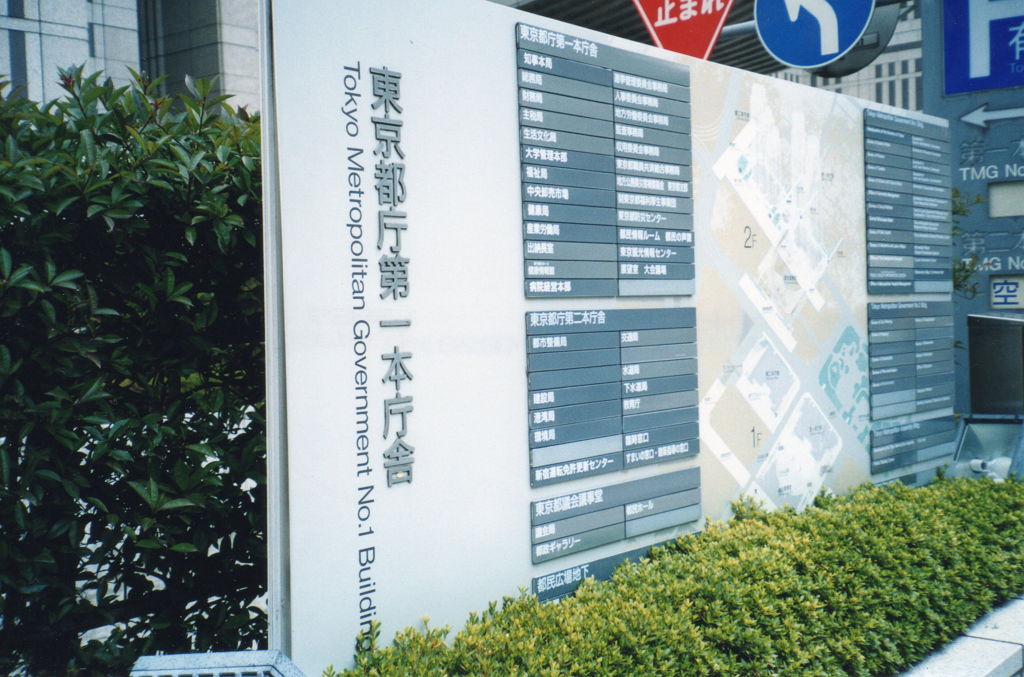
Directory at the Tokyo Metropolitan Government Building
Today we went to Shinjuku for sightseeing and to activate my family’s JR rail passes.
The JR Rail pass is a must purchase for visitors to Japan that will be doing a lot of traveling. Passes are available in 7, 14, and 21 day versions. They allow free transportation on all JR trains, all local JR busses, the Narita Express, and all except the fastest shinkansen. You need to purchase the pass before you travel to Japan, and then activate it when you arrive. The time period starts as soon as you activate the pass. Unfortunately the JR Rail Pass is not available for foreign residents of Japan, only visitors.
The closest place to Noborito to activate the JR rail pass was in Shinjuku. We boarded the Odakyu line and took the 20 minute ride into Shinjuku station. The plan was to quickly activate the passes, get lunch, and then explore Shinjuku for the afternoon.
It took us a while to actually find the travel office where we could activate the rail passes, and when we arrived we found a huge line of people ahead of us. By this point I was already hungry and looking forward to lunch. After waiting for about half an hour, we were at the front of the line. I asked my parents if they could take care of the passes themselves while I got something to eat. They were worried about doing something wrong or needing to speak Japanese, so I had to stay.
By the time the rail passes had been exchanged, I was ravenous. The staff at the travel office spoke English very well, which was good because I am pretty useless when hungry, and the Japanese language part of my brain had shut down. I declined their offer of help to book a hotel in Kyoto so we could leave sooner. Just before 2:00pm my family walked out of the travel office with active rail passes and one grumpy translator. Eventually we found a nearby Becker’s Burgers in the underground mall and I proceeded to stuff myself.
Now that I was fed and feeling like a human again, we left the sprawling Shinjuku station and started to explore the area. I walked my family down the main streets, near all of the restaurants, stores and pachinko parlours. I took them through the NS building and showed them the world’s largest water clock, which was the first landmark that I had seen when I arrived in Japan in September. In addition, we went to the Tokyo Metropolitan Government Building.

The government building, also known as Tokyo City Hall, has two large towers on each side of a central structure. Each tower has a free observation level on the 45th floor that provide breathtaking views of the Greater Tokyo Area. On a day with no clouds and minimal smog you can see Mt. Fuji. We had no such luck.
After completely overwhelming my family with tall building after tall building, we returned to Noborito to get packed for our 3 day excursion to Hiroshima, Kyoto, and Numazu. We all tried to watch a DVD in my room, but everyone was still jetlagged from the travel and we all had an early night.
(2014 Update) The JR travel offices that can be found in major train stations and airports are fantastic. They are happy to help you make your travel and hotel plans, and they can provide maps and recommendations for places to see. The best part is that they can do all of these things in English. Just make sure you get some lunch first – the lines can be long!
June 30, 2004 – Yokohama
Posted by Barniferous in Visitors, Yokohama on July 20, 2014
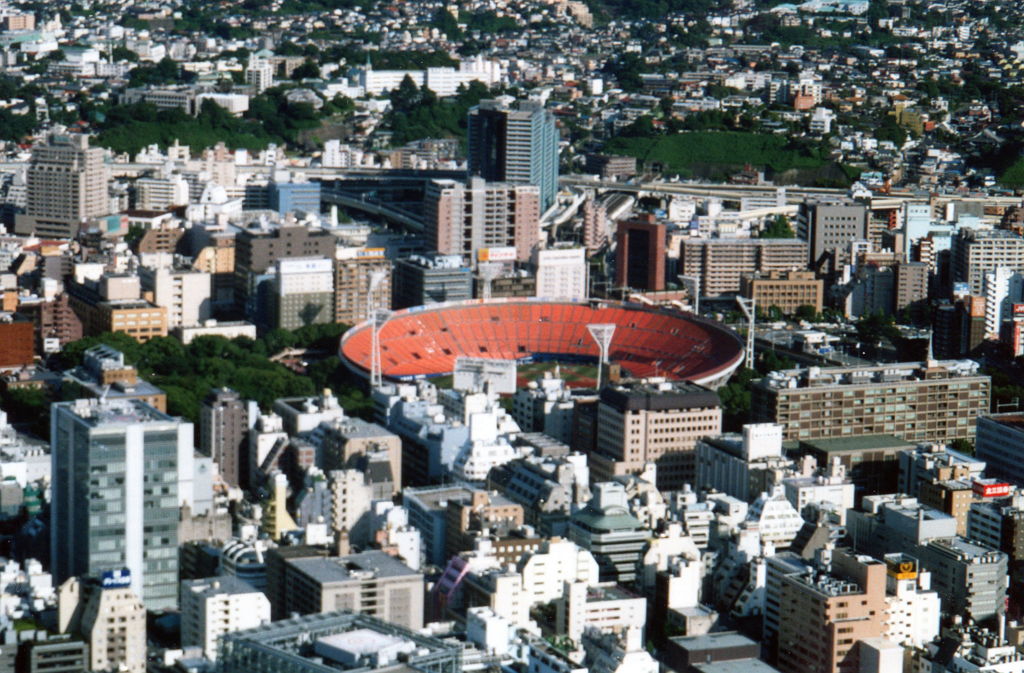
A view of Yokohama from Landmark Tower
Today I took my family to Yokohama. We took the Nanbu line from Noborito to Kawasaki, Tokaido Line from Kawasaki to Yokohama, and then switched to the still shiny new Minatomirai line to finish our trip to Minato Mirai station.
I had been to Yokohama several times before, but this was the first time I had ever gone inside Landmark Tower, Japan’s tallest building. There is an observation level on the 69th floor that is accessable by one of the world’s fastest elevators. The observation level offers amazing views of Yokohama, Kawasaki, Tokyo and on a clear day, Mt. Fuji. The ocean is on one side, and there is continuous city in every other direction as far as you can see. My family was feeling a bit overwhelmed by the neverending city.
From Landmark Tower we wandered around the Minato Mirai area. My mom bought a Hard Rock Cafe t-shirt, and I made sure to show off the dog walking video game at the nearby game center.
After exploring Minato Mirai, we took the train to Yokohama Chinatown. We spent a long time walking around the streets and enjoying the buildings. My mom and sister requested that we stop in a large tea shop. There were different kinds of tea from around the world from floor to ceiling. While my sister tried to communicate with the store owner, the owner’s young daughter (maybe 5 years old) came up to my mom and started talking to her in Chinese. My mom responded in English, so the conversation really didn’t go anywhere. My mom ended up giving the young girl a Canadian flag pin, which got a nice smile and some thanks from the owner.
My family enjoyed their day in Yokohama. Even though I did a very similar visit with my friends a month ago, I still had fun. Yokohama is a great place to visit.
(2014 Update) In 2014 the Abenobashi Terminal Building opened in Osaka, which is about 4 meters taller than Landmark Tower. Landmark Tower is now number two in Japan.
June 29, 2004 – Ueno Park, Homelessness, and Museums
Posted by Barniferous in Tokyo, Visitors on July 20, 2014
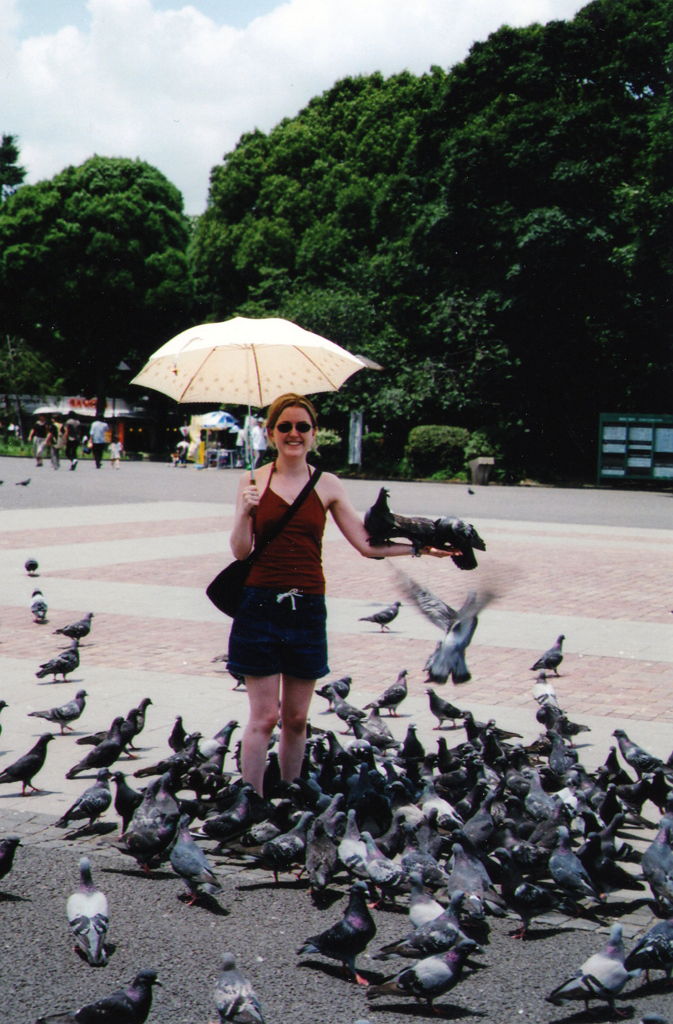
My sister feeding pigeons in Ueno Park
Today I took my visiting family out to Ueno Park. We got moving after breakfast and took the Odakyu line from Noborito to Shinjuku, then the Yamanote line to Ueno station. My family was impressed that all of the trains arrived exactly when they were supposed to. Mass transit in Canada is nowhere near as punctual.
We explored Ueno Park, enjoying the trees, duck pond, and the people. In one of the large open areas there was an older man feeding pigeons. Pigeons are a very common sight in parks and temples in Japan. The man was standing in the middle of hundreds of pigeons, distributing bread crumbs. My sister walked into the middle of the pigeons for a picture. The man approached her and offered her some bread crumbs. The pigeons were so used to being fed that they literally ate right out of my sister’s hand!
After feeding the pigeons, we headed towards the Tokyo National Museum. Just before we got to the museum we saw something that I hadn’t seen before – a huge group of homeless people. A local mission was distributing sandwiches and was also providing free haircuts.
Japan overall is a wealthy and successful country, so many visitors to the country are surprised that there are any homeless people at all. Officially there are about 25,000 homeless people in Japan. You can easily find makeshift shelters built from cardboard boxes and tarps in Ueno Park, Yoyogi Park, and in various areas around Shinjuku. Most of the homeless people are older men.
We continued walking towards the Tokyo National Museum. I had been to the museum with my friends less than a month earlier, but it was still incredibly interesting. I could probably spend a few days in the museum and not get bored. We spent a few hours exploring the extensive Japanese collection, with much of our time devoted to the popular attractions – swords and armor. Like my friend previously, my family tried to take a lot of pictures, and most of them came out blurry.
When we finished with the museum, we started the journey back to Noborito. Since my dad does not like crowds, we got reserved seats on the limited express from Shinjuku to Noborito. This allowed us to have our own seats and avoid all of the usual pushing and shoving. The cost was about 600 yen each, but I think my dad would have paid more to avoid the packed commuter rush.
It was a good day out in Tokyo, and we are looking forward to exploring in Yokohama tomorrow.
(2014 Update) I think it’s interesting that we saw both pigeons and homeless people lined up in Ueno Park looking for some food. People were happy to see the pigeons, but many people were uncomfortable by the presence of the homeless people.
Sanyukai is one of Japan’s largest homeless charities. Check out their English website here. There are other organizations as well, and they are all doing very important work. If you aren’t in Japan, see what you can do in your own community. Shelters and food banks rely on their volunteers to survive. Your donation of time, money, or clothing can make a huge difference to someone who really needs it.
Please excuse the delay
Posted by Barniferous in Uncategorized on July 7, 2014
Unfortunately real life has interfered with my blogging time, so I am running a bit behind on new posts. The goal of this blog is to post entries exactly 10 years after they actually happened. If all goes well I should be caught up again in the next week or two. Stay tuned!
Drinking in Japan
June 28, 2004 – Beer at the movies
Posted by Barniferous in Life in Japan, Movies, Visitors on July 2, 2014
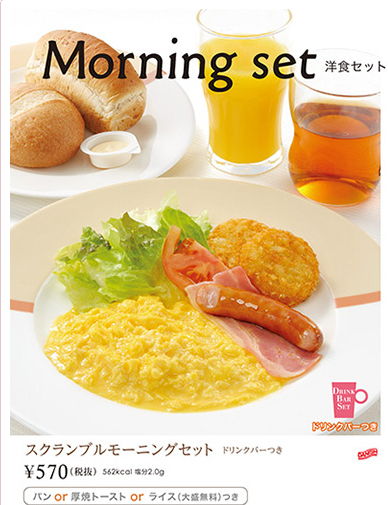
One of the breakfast options at Jonathan’s
In the morning I gathered up my family and we went for breakfast at Jonathan’s, a family restaurant near Mukogaoka Station. Jonathan’s has a breakfast menu with some familiar foods that I thought wouldn’t scare my family. They were a little surprised that the standard eggs and meat breakfast came with salad instead of some kind of potatoes.
After breakfast we spent a few hours exploring the nearby Daiei store. Supermarkets in other countries are always interesting. Like my other visitors, my family commented on the huge fish section and small meat section, which is exactly the opposite of supermarkets in central Canada.
My family wanted to have a fairly uneventful first full day in Japan. After exploring the neighbourhood and stores around the Noborito area. we headed back to Hello House. My parents wanted to have a nap before our evening plans of dinner and a movie. My sister and I went to wake them up two hours later from a deep sleep. They woke up confused and disoriented, believing it to be morning instead of evening. First time jet lag is terrible!
After finally convincing my parents that it was still Monday afternoon, we all walked to Noborito station and took the Odakyu line to Shin-yurigaoka station. There is a large shopping area and movie theatre near the station, with lots of good restaurants. Our first stop was the movie theatre to get tickets for later. My parents and I got tickets for Harry Potter 3, while my sister got a ticket for The Day After Tomorrow (she had already seen Harry Potter). The family was pleasantly surprised to see that the theatre offered reserved seats, so we wouldn’t have to rush back and line up before the movie.
We wandered through the huge selection of restaurants in the department store’s upper floors. My mom and sister wanted noodles, but my dad wanted something with meat. Fortunately the restaurants had a ticket system, so he would not need to communicate with anyone.
Restaurants with a ticket system are common in Japan, usually in train stations or other areas with high customer volumes and limited menu options. You simply insert money into the ticket machine and then push the button corresponding to the food you want. The machine will return a ticket with your order. After you have your ticket, you can sit anywhere in the restaurant and present the ticket to the waiter that comes by. Within minutes you will have your food.
I helped my dad buy a ticket from the machine, and took my mom and sister to get some noodles. In Canada there is a perception that Japanese portion sizes are small. They were shocked when the waitress returned with bowls of soup large enough to bathe a baby in. (author’s note – do not bathe a baby in soup).

We met up after dinner and returned to the movie theatre. I translated the snack menu, which was easy because it was mostly in katakana. When I got to the drinks I noted that beer was available. My dad asked if I meant actual beer, the kind with alcohol. I told him yes, they sold cans of Asahi Super Dry. With a huge smile on his face my dad got me to order him a can of beer for the movie.
The movie, like the others in the Harry Potter series, was fantastic. I tried to read as many of the Japanese subtitles as I could while watching. My dad smiled the whole time while sipping on his can of beer. After the movie we returned to Hello House and called it a night.
It was a great first day in Japan for my family.
Explore neighbourhood
Beer at movies
June 27, 2004 – My family arrives in Japan
Posted by Barniferous in Hello House, Tokyo, Visitors on June 27, 2014
A mere 19 days after I dropped off my University friends at Narita airport, I was once again taking the cheap trains to pick up visitors. This time I would be picking up my parents and sister.
My parents would have never considered traveling to Japan if I wasn’t living here. In fact, they have never traveled outside of North America before. My parents are in their mid 50s and live in a small town west of Winnipeg. My father is an air traffic controller – he was in the Canadian Forces for 27 years, retired, and then started doing the same job as a civilian. He is one of the friendliest people I know and has no issues starting a conversation with complete strangers. My mother is a teacher’s assistant at an elementary school. She specializes in helping hearing impaired and deaf students. My sister is a University student who lives in Winnipeg. She is in her early 20s, short, and very smart. However, she will believe almost everything I tell her, a fact that I occasionally abuse for comedic effect.
When I picked up my friends from the airport, I ended up having to wait a long time for them to clear customs and immigration after their flight landed. I had considered arriving about an hour after my family’s flight landed, but was worried that if they somehow got through early, they would be worried that they couldn’t find me. I got to the airport exactly when their flight arrived, and ended up having to wait about 90 minutes for them to show up.
At this point it had been 9 months since I had seen my family. My sister looked mostly the same, but my parents looked older. They all commented on how skinny I looked, since I had probably dropped about 5kg (12lbs) since moving to Japan.
We got tickets for the Narita Express and were on our way to Shinjuku from the airport. Just like my first train ride into Tokyo, and my friends after that, my family was amazed at the size and density of the city. Everyone always gets excited, and then they realize they are only in Chiba and things are only going to get busier.
We made a brief stop in Shinjuku to look at the skyline. The largest city my family had ever been to was Toronto. Tokyo is like stacking a few Torontos on top of each other. I taught them all how to use the train ticket gates, and we headed off for Noborito.
I couldn’t get the same guest room in Hello House East that my friends had, however I got a bigger, nicer room in Hello House West for my parents. They were impressed with the room (and the price), but were a little concerned about sleeping on futons on the floor. My sister was going to stay in my room on my futon, and I would sleep on my foldy floor couch. After giving them all of the key information on Hello House (where the bathrooms and coin operated showers were located), we decided to head out and get some food.
My dad can be pretty adventurous with food, but my mom and sister aren’t as much. To ease them into their Japan experience, we ate at a Spaghetti restaurant near Mukogaokayuen station. We walked from Hello House, and my family enjoyed looking at all of the different businesses along the way. Everyone ordered fairly non-threatening spaghetti (no squid ink sauce for anyone), and we had our first meal as a family in 9 months.
I really missed my family and was happy they came to visit me! It’s going to be a great few weeks!
(2014 update) My dad told me later that he had brought two apples to eat on the plane. He finished one, and kept the other in his carry on luggage. When the customs staff asked if he was carrying any fruits or vegetables, he pulled out the apple. The customs staff told him that he would have to dispose of the apple before he could enter the arrivals lounge. He considered arguing or eating the apple in front of the customs staff, but instead tossed the apple in a nearby garbage bin.
June 13, 2004 – Music and movies with The Penpal
Posted by Barniferous in Hello House, Life in Japan, Movies, The Penpal on June 26, 2014
Today The Penpal came from Numazu to visit me in Kawasaki again. We hung out in my room at Hello House and listened to music. Afterwards we watched my Pixies DVD. I also practiced my Japanese by trying to retell the story about Green attempting to eat 20 Frosties at Wendy’s in Japanese. The Penpal understood my explanation of the story, but couldn’t understand why someone would try to eat 20 Frosties at one time. If I can’t explain it in English, I have no chance of explaining it in Japanese.
After she returned to Numazu, I went to the video store and rented American Beauty and Silence of the Lambs. I had seen both before, but they were both excellent.
(2014 Update) The ending of Silence of the Lambs continues to be terrifying even years later.
 Drinking in Japan
Recent Comments