Archive for category Places in Japan
July 6, 2004 – Ginza and Sensoji in the heat
Posted by Barniferous in Tokyo, Visitors on August 8, 2014
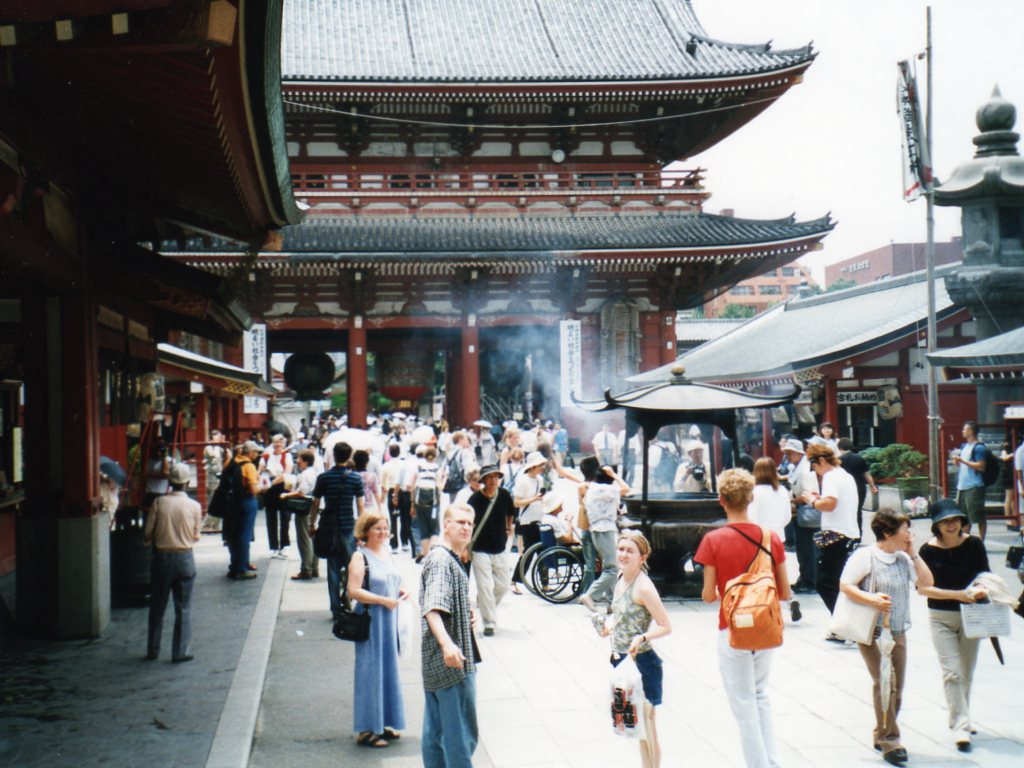
A hot day at Senso-ji
Today was a great example of why checking weather information before traveling is important. It was WAY too freaking hot.
After taking a day off yesterday, my family and I were back on the train for another day of sightseeing in Tokyo. The first stop was Ginza. We wandered around the area, checking out the high end stores and the iconic Kabuki-za theatre.
By noon, the temperature was creeping above 30 degrees. There are 30 degree days in central Canada in the summer, but there are two main differences between Tokyo heat and Winnipeg heat; humidity and urban heat islands.
The humidity today was in the high 80% range. To compare, the average summer humidity in Winnipeg is around 50%. Humidity in the 80% range feels like walking around with a hot damp towel wrapped around you. This makes a hot day feel even hotter.
Urban Heat Island is term used to describe cities being hotter than rural areas. Tokyo is largely concrete and steel with little green space. The general idea is that heat is absorbed instead of reflected, and plants are not able to cool the air by expelling water vapour. The effect on a hot, humid day is not very pleasant.
We cut our trip to Ginza short due to the heat, but we did make sure to walk as close as possible to the automatic doors of the stores in the area. Every time they opened, we got a frosty cold blast of air conditioning. We retreated to the relative comfort of the subway system, and then moved on to Asakusa.
In my opinion, Sensoji temple is a required visit for all tourists in Tokyo. In my 9 months living in Japan this was my third trip to Sensoji, but it was still enjoyable. I helped my family buy souvenirs for friends and family at home.
We didn’t have the longest day of sightseeing due to the heat, but it was still fun. We were all happy to get back to Hello House and turn on the AC.
(2014 Update) My mom and sister still use the folding fans they bought in the stores leading to Sensoji 10 years ago. I did eventually get to watch kabuki in the Kabuki-za theatre, but not until 2006. Stay tuned faithful readers… stay tuned.
July 5, 2004 pt1 – We can’t go to Daiei anymore
Posted by Barniferous in Greater Tokyo Area, Visitors on August 2, 2014
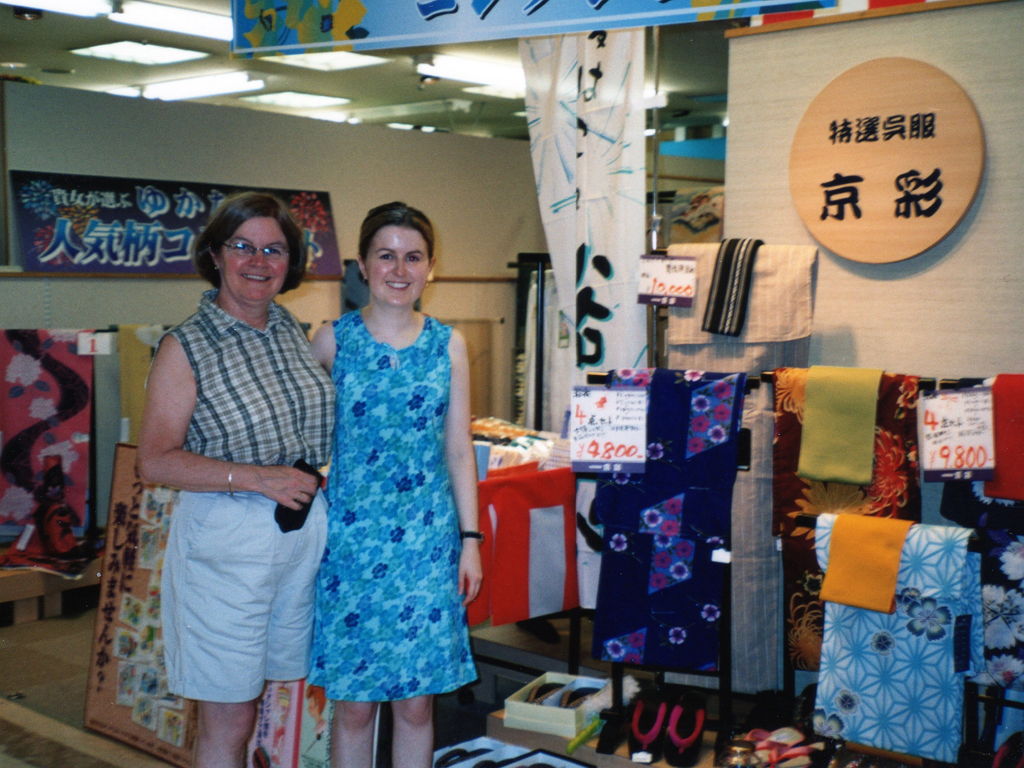
My mother and sister in the kimono section of Daiei
After a few grueling days of traveling, my family decided that they wanted to take a day off and stay close to Hello House. I got a chance to catch up on some relaxing and video games, but my sister wanted to do some exploring.
The week before, I gave her directions to the Daiei department store near Mukogaokayuen station, which was only a 5 minute walk from Hello House. She returned after buying herself a Hello Kitty watch, feeling quite proud of herself because she didn’t get lost.
Today she went to Daiei again by herself. She came back an hour later looking distressed and said “we can’t go to Daiei anymore”. I asked her to explain.
It seems that she went to look at the kimono and yukata section of the store. The sales people came over to help, and before she knew it, she was trying on different fabrics, belts and accessories. “I looked like a princess” she told me, while trying to get through the story.
After trying on several combinations of clothing, the sales people started packing up everything and taking it to the cash register. My sister, who just went to look, had no ability to explain that she was not actually interested in buying. She somehow managed to communicate to the store staff that she didn’t have any money, but her dad would come back to pay for everything. When the message got through, she left the store and returned to Hello House.
Having been in a few awkward situations without the ability to communicate, I could completely understand her feelings. I tried my best not to laugh, and promised that we wouldn’t go back to Daiei before my family returned to Canada.
To the staff at Daiei, please accept our apologies for the confusion. Also, thanks for making my sister look like a princess, even for a few minutes.
July 4, 2004 – Meeting of the families
Posted by Barniferous in Shizuoka, The Penpal, Visitors on July 31, 2014
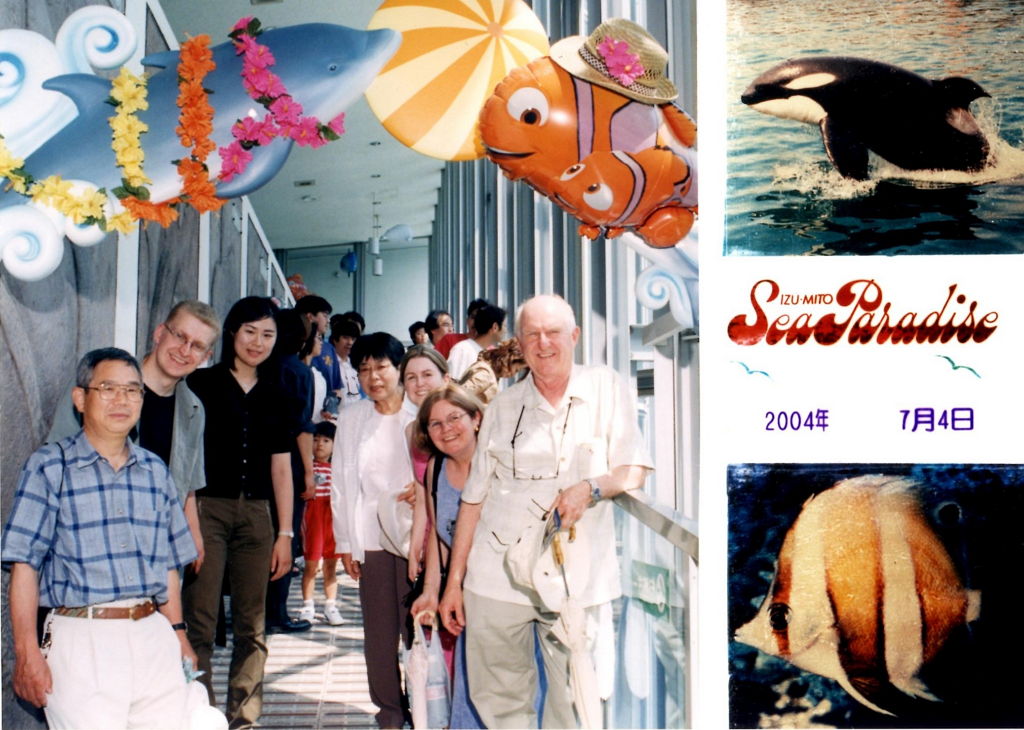
From L to R: Penpal’s father, me, Penpal, Penpal’s mother, my sister, my mother, my father
On the morning of July 4, my family and I checked out of our hotel in Kyoto and boarded the Shinkansen for Mishima. The Penpal (who as you all remember is also my girlfriend), and her family wanted to show us around their hometown of Numazu in Shizuoka prefecture.
On the train, I told my family that The Penpal’s parents were traditional Japanese parents and couldn’t speak any English. It was going to be their first time spending the day with foreigners. My family is usually very polite and friendly, so I wasn’t terribly worried. However, my parents are huggers. I reminded them that Japanese people aren’t big on physical contact, so they might bow or shake hands as a greeting, but hugs were right out.
The Penpal and her parents were waiting for us at Mishima station. She introduced my family to her parents, who proceeded to give the Penpal’s family big Canadian hugs. Urgh.
The Penpal’s father drove a small Nissan, which was not big enough for the 7 of us. We divided up our group – the men went in the Nissan, and the women all piled into The Penpal’s tiny Honda. The idea was that we would have one translator in each car. We took off towards our first destination – Izu Mito Sea Paradise.
The ride to Sea Paradise took about twice as long as it should have due to Sunday traffic. I have never understood why every Japanese person with a car decides to go for a family drive on Sundays. The narrow streets end up looking very much like parking lots. During the long ride I did my best to translate between my father and The Penpal’s father. I did remarkably well considering my limited vocabulary.
When we got to Sea Paraside, The Penpal’s father opened his trunk and pulled out a couple of cans of cold Yebisu beer for my father and I. My dad was confused, so I explained that drinking in public was allowed in Japan. He still seemed a bit hesitant, and waited for us to get a seat at the dolphin show before drinking his beer.
My father and The Penpal’s father were both wearing a nearly identical hat and pants (slacks for you British people who are now giggling). During the dolphin show, the Sea Paradise staff brought out a large trained walrus. As the giant walrus got close to the water, the staff announced in Japanese that the first few rows would likely get wet. My father and The Penpal’s father, with no communication between them, both stood up at the same time and stepped over their seats to the next row, both stepping with the same leg first. It was like watching a bizarre mirror image.
After Sea Paradise, we all loaded back into the cars and drove to Uobun, a Numazu tempura restaurant that has been in business for 100 years. The restaurant was exactly the kind of place that foreigners would avoid; there were no models of food outside, no English signs anywhere, and the menu was all written in Japanese on the wall behind the chef. The Penpal’s father ordered tendon (天丼) for all of us. Don’t be confused by the spelling – in this case tendon is “tempura donburi”, not tissue that connects muscle to bone. We all got a big bowl of fish, shrimp and squid fried in delicious tempura batter served over rice. Lunch was fantastic, and before we knew what was happening, The Penpal’s father had snuck away to the cash register and paid for everything.
We thanked him for lunch and then piled into the cars again. Our next stop was The Penpal’s house. This was my first time to ever visit her house. We all sat into the living room and The Penpal did her best to translate conversation over tea. The parents swapped stories about when we were kids, and then The Penpal showed off her piano skills for my family.
We spent a few hours at the house and then decided to go out for dinner. By this point in the day, the Penpal’s mother was a big fan of my sister because she was “kawaii”. They sat across from each other at the table, and The Penpal’s mom started trying to teach my sister some Japanese by pointing out items on the table and getting my sister to repeat their names. Hey, whatever gets my girlfriend’s family to like my family is a good thing.
While we were eating, I leaned in and quietly told my father that he should pay for dinner. The Penpal’s family had driven us around all day and treated us to lunch and I wanted to even the ledger a little. Like most Japanese restaurants, the bill is left at the table when the food arrives. I created a distraction and sent my father running for the register with the bill. There was the usual polite protest, but I insisted that it was the least we could do. It’s much easier to be generous with other people’s money 🙂
Outside the restaurant my sister asked me to teacher her some Japanese to thank The Penpal’s family for showing us around all day. I was about to teach her how to say “domo arigato gozaimasu” (a polite thank you), but instead I got her to practice “watashi wa okii neko desu” (I am a big cat). My sister has an amazing ear for language, and was able to pick up the phrase and correct pronunciation immediately.
The Penpal’s family dropped us off at Mishima station. Everyone started saying their goodbyes when my sister walked up to The Penpal’s parents and used her new sentence “I am a big cat”. She smiled and bowed while saying it. They looked confused. Worried that she had pronounced it badly, she tried again, speaking slowly and clearly. The Penpal, looking confused, explained “Lisa-chan – you just said that you are a big cat”. At this point I cracked up laughing while my sister started yelling at me. Being a big brother is awesome.
I am very happy that my family and The Penpal’s family got along. Most tourists only get to see famous places in Japan, but thanks to The Penpal’s family, we got to drive around, visit a Japanese house, and eat fantastic food at places that tourists would usually avoid. For the wonderful day we spent together, I would like to say 私は、世界最大の猫です。 I assume it means thank you.
July 3, 2004 pt3 – Kaiten zushi
Posted by Barniferous in Visitors, Western Japan on July 29, 2014

Not my picture – thanks Wikipedia!
After a long day of sightseeing in Kyoto, my family and I were back near our hotel and hungry. By this point in the trip, my mom and sister wanted a break from Japanese food. They saw a McDonalds in Kyoto station and were determined to get some familiar food. My dad reminded them that they could eat McDonalds in Canada, but they didn’t care. To compromise, my father and I dropped off my mother and sister at the golden arches and then set out to find some Japanese food.
There are way too many restaurants in and around Kyoto station. After looking around for a while, we settled on a small small kaiten zushi restaurant. Kaiten zushi (the s in sushi becomes a “z” after kaiten) restaurants have a conveyor belt that moves plates of sushi through the restaurant. Smaller restaurants will have the chefs in the middle with sushi moving around them. Larger restaurants will have huge conveyors that wind their way through the restaurant.
Our restaurant was relatively small, so we sat at the counter. We ordered beer, and were amused to find that our glasses were filled by an automatic beer pouring machine. The machine tilted the glass at an angle, and the spout moved along the inside of the glass to reduce the head. Near the top, the machine returned the glass to an upright position and added a tiny bit of foam to the top. The machine created a perfect pour every time, and was a lot of fun to watch.
We had a few sips from our perfectly poured beers and then turned our attention to the conveyor belt and the tiny plates of sushi going by. Like other kaiten zushi restaurants, the plates were colour coded by price. My dad seemed confused, so I told him to just grab anything that looked good as it was going by. The problem was that he wasn’t very familiar with sushi, and didn’t know what was good. I selected a few pieces of the least threatening sushi as they passed our section of the counter. After a enjoying the first few pieces, he started to make his own selections, trying some familiar fish and some more adventurous choices. Several plates and another beer later, we were both pleasantly stuffed.
After dinner we took a walk around the station building and surrounding area. Unlike major train stations in Tokyo, there wasn’t a lot going on around Kyoto station. We passed a number of small izakayas, and thanks to the window models I was able to instruct my dad on the difference between jocky (a regular size glass of beer), daijocky (a big glass of beer), and the rare but impressive super jocky (a really big glass of beer).
Near the station we walked by a pachinko parlour. Like many foreigners, my dad was confused by the concept. I explained that gambling for money was illegal, but you could win a small prize and then sell it for cash at the nearby prize exchange. He sounded skeptical until we walked by the prize exchange window.
When we had our fill of exploring, we returned to the hotel to find my mother and sister were happy with their McDonalds dinner, and that they had also done some minor exploring in the stores around the station. I am sure they had fun, but I really enjoyed the beer and sushi with my dad. When I was growing up, my dad was always interested in taking me to new places and teaching me new things. It was great to get the opportunity to return the favour.
July 3, 2004 pt2 – Pulling rank
Posted by Barniferous in Shenanigans, Visitors, Western Japan on July 28, 2014
Other than the amazing sightseeing, my personal highlight from my day exploring Kyoto with my family occurred as we were ready to leave Kinkakuji. It involves a conversation between an American soldier and my sister.
There are about 50,000 American military personnel stationed in Japan. This is due to a treaty signed with Japan at the end of World War 2. The United States has pledged to defend Japan in cooperation with the Japanese Self Defense Force. Due to the large numbers of servicemen, it’s not uncommon to encounter them especially in popular tourist areas.
There were a small group of American soldiers in civilian clothes doing some sightseeing. While we were taking a short break before returning to the hotel, one of the soldiers started chatting up my sister. She seemed to enjoy the attention of the nice looking young man.
At some point my dad walked over, which forced my sister to awkwardly introduce him. The young man shook my dad’s hand politely. Then my sister mentioned that my dad was a retired Captain in the Canadian Forces. Instantly the young American snapped to attention, standing straight and tall. My dad tried to engage him in some small talk, and the soldier started responding with “yes sir” and “no sir”. He seemed to be intimidated by my very non threatening father. My sister was not amused at all.
Shortly after the soldier excused himself to rejoin his friends. My sister was annoyed, my dad didn’t understand why, and I stood off to the side laughing. Good times!
(2014 Update) My dad could have been a Major, but turned down a promotion so we didn’t have to move while I was in the middle of high school and my sister was in the middle of junior high school. If the young American soldier reacted so strongly to a Captain, I would have loved to see his reaction to a Major!
July 3, 2004 pt1 – Wabi sabi – Kyoto style
Posted by Barniferous in Visitors, Western Japan on July 27, 2014
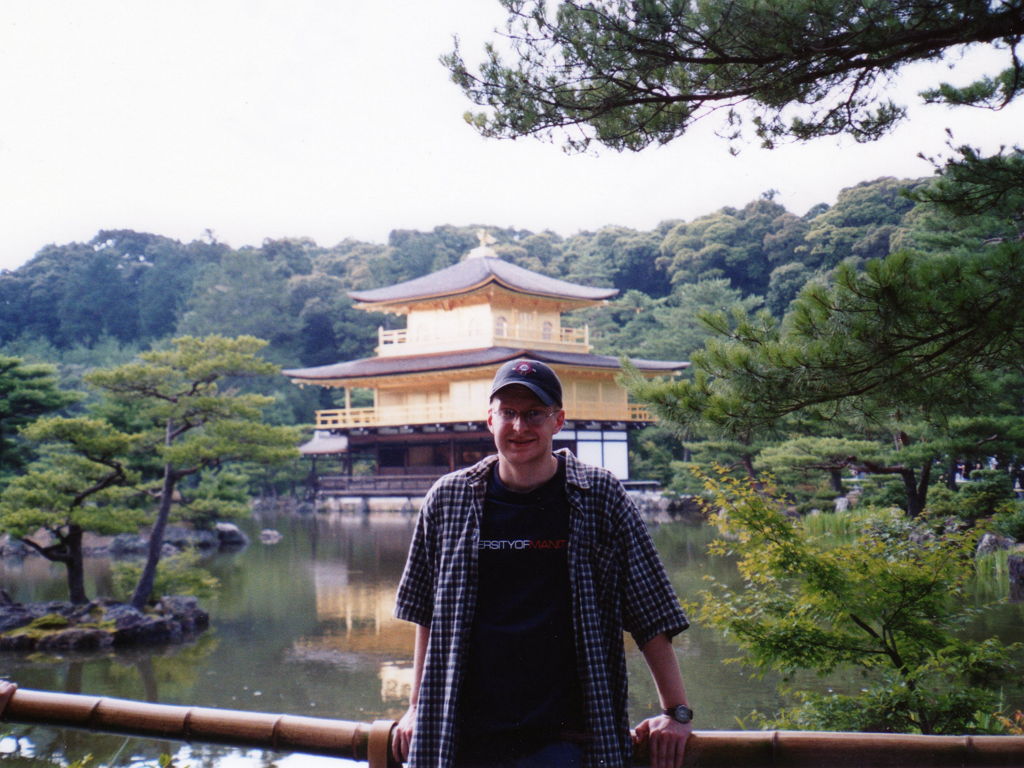
Me at Kinkakuji. Please note the Winnipeg Jets hat and the University of Manitoba shirt.
My family and I spent the day exploring parts of Kyoto, which was the capital of Japan until 1868. Kyoto is home to some of the oldest and most famous historical buildings in Japan, making it a very popular destination for tourists. All of the main tourist areas offer service and signs in multiple languages. Getting around is easy, with a small subway system and very well labelled buses. Tourist maps are available showing the location of all of the major tourist sites.
On our day in Kyoto, we went to three places: Nijo Castle, Daitokuji and Kinkakuji.
Nijo Castle in central Kyoto was our first destination. I love castles, so I made it a point to get Nijo on our itinerary for the day. Nijo is not the typical giant stone building that looks out over the land. It is a series of one story structures connected together, surrounded by beautiful grounds and a moat. My favourite feature of the castle was the nightingale floors – floors designed to squeak at the slightest touch. These floors were installed as a security feature so you could hear people coming.
From Nijo Castle, we went to north Kyoto to see Daitokuji – a large temple complex with several sub temples. I can’t remember the names of the places we went within the Daitokuji complex, but we did see a traditional zen garden with combed rocks. It was very relaxing.
Our main event of the day was Kinkakuji, the golden pavilion. Kinkakuji is by far the most popular tourist spot in Kyoto for foreign visitors. It is a Buddhist temple on a lake covered in gold leaf. The golden shine is striking, and easily visible from a distance. The original temple was founded in 1397, after being converted from a wealthy businessman’s villa. It was destroyed in the mid 1400s during the Onin war and rebuilt. In 1950, the temple was burned to the ground by a mentally ill monk. The current structure dates from 1955.
While foreign visitors love Kinkakuji, most Japanese people prefer the similarly named Ginkakuji, the silver pavilion. The name is deceptive – the original plan was to cover the structure with silver foil similar to the gold foil covering on Kinkakuji, but the covering was never finished. The difference in preference between the two temples illustrates the Japanese concept of “wabi-sabi”, which is a concept nearly impossible to translate fully into English. The best explanation of wabi-sabi that I ever heard was from The Penpal: a new stone carving is beautiful, but Japanese people think it’s more beautiful if it has been exposed to the elements for years and has some cracks.
It’s interesting to me that a country that strives for perfection in nearly everything also values the beauty in imperfections. I have learned a lot about Japan and it’s culture, but I don’t think I can ever truly understand everything. I can appreciate a peaceful rock garden however; they are the best.
July 2, 2004 pt3 – Where is the f**king hotel?
Posted by Barniferous in Visitors, Western Japan on July 24, 2014
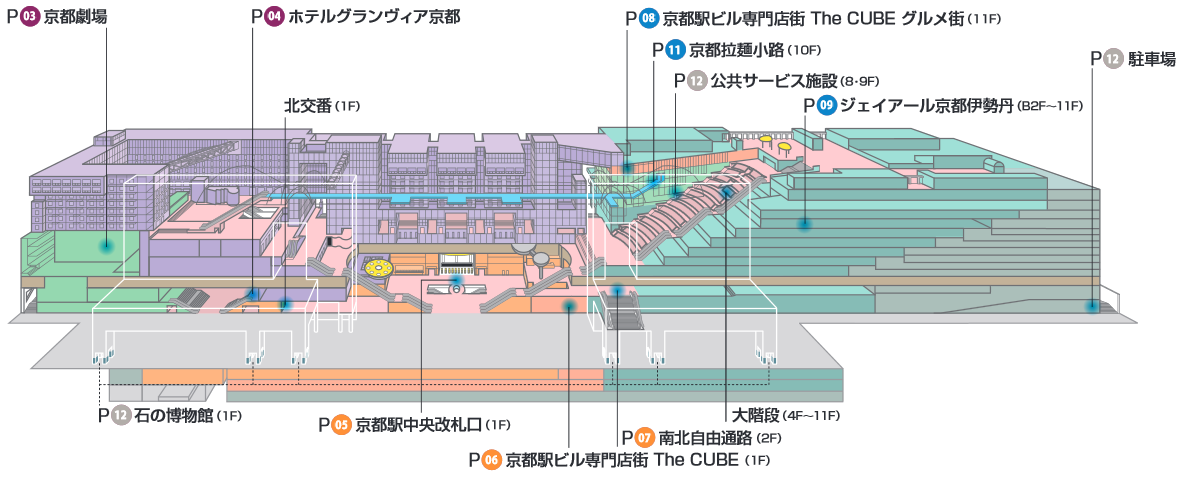
My family and I started July 2 in Kawasaki, then traveled to Hiroshima and visited the Peace Memorial Park. The third and final stage of our long day of travel was returning to Kyoto and checking into a hotel.
From Hiroshima we took the shinkansen to Kyoto station. Yesterday I made an online reservation at the Dai-Ni Tower Hotel in Kyoto, which was described as “just in front of JR Kyoto station”. The only problem was that Kyoto station is HUGE. The station itself is Japan’s second largest station building. In addition to having train service on JR, private train companies, and Kyoto subway, the station also features a shopping mall, movie theatre, and government services. If you need to do anything other than sightseeing in Kyoto, chances are good that you can find it at Kyoto station.
We got off the train with our bags, and then tried to find an area map. The station was so huge that the map was not helpful at all. I decided it was time to test out my Japanese ability and ask for directions. I found a nearby station information booth, approached it and asked the friendly attendant how to find the Dai-Ni Tower hotel.
Asking “where is blabla” is one of the first things people learn in a new language. In Japanese, it is very simple: “blabla wa doko desu ka?”, where blabla is the person, place, or thing you wish to know the location of. The difficult part is understanding the answer.
The helpful attendant looked relieved that I could speak some Japanese, and then proceeded to give me 5 minutes of detailed instructions at high speed. I got him to repeat the instructions, and tried to follow along with language and hand gestures. The directions were as follows:
- Walk to the end of the station
- Turn left
- Walk half way through a bunch of restaurants and stores
- Turn left
- Walk half way down another long hallway
- Go down some stairs
- Walk underground for a while, taking a slight right
- Go up some stairs
- ????
- There’s the hotel
We did pretty well following the instructions until the last part. We left the underground area at the wrong exit, and ended up at the back of Kyoto station with no Dai-Ni Tower hotel in sight. After unsuccessfully trying to find an area map, I got my family to wait nearby with the luggage while I tried to find someone else to get directions from. After a search, I ended up learning that the hotel was very close to where my family was sitting.
I returned to find my sister in a hilarious conversation with some drunk businessmen. They were trying (very poorly) to flirt with her in English by talking about how her gaijin nose was so nice and their Japanese noses were very flat. She declined an offer to go for a drink, and we were on our way.
At the hotel we learned that the online reservation didn’t work, but the hotel quickly found us rooms at the online rate using excellent English. We got our room keys and rode a tiny elevator up to our rooms.
I can’t speak for people from other parts of the world, but North Americans are always shocked by the size of Japanese hotel rooms. My parents had their own room, and my sister and I shared a room. If we could have knocked out the wall between the two rooms it would have been about the size of a typical Canadian hotel room. It was small, but at least we found the f**king hotel.
(2014 Update) Despite our difficulty in finding it, I would recommend the Dai-Ni Tower Hotel. It is located close to the station, is clean, quiet, and reasonably priced. Look it up on your favourite map website first, or make good use of any mobile device with GPS. Also, travel light: the only thing less fun than being lost is being lost while transporting large bags. Travel light!
July 2, 2004 pt2 – Hiroshima Peace Memorial Park
Posted by Barniferous in Visitors, Western Japan on July 23, 2014
After spending the morning traveling from Kawasaki to Hiroshima at high speed, my family and I were looking for some food. It’s always a safe bet to find inexpensive and quick food at major train stations. We quickly found a small restaurant with a display of plastic food outside that looked good. When we went inside, the menus were all text with no pictures. Most of the characters were beyond my Japanese ability. The nice waitress, likely familiar with foreign tourists, took us outside the restaurant to look at the food models so we could order.
When it was my turn to order, I told the waitress in Japanese that I would like the una-don, which is grilled eel on rice. Not sure if I knew what I was ordering, the waitress responded with “unagi wa… eigo de… this is eel”. I responded in Japanese telling her that I loved eel. When our food arrived, my rice had a huge piece of eel on top. I love Japanese service!
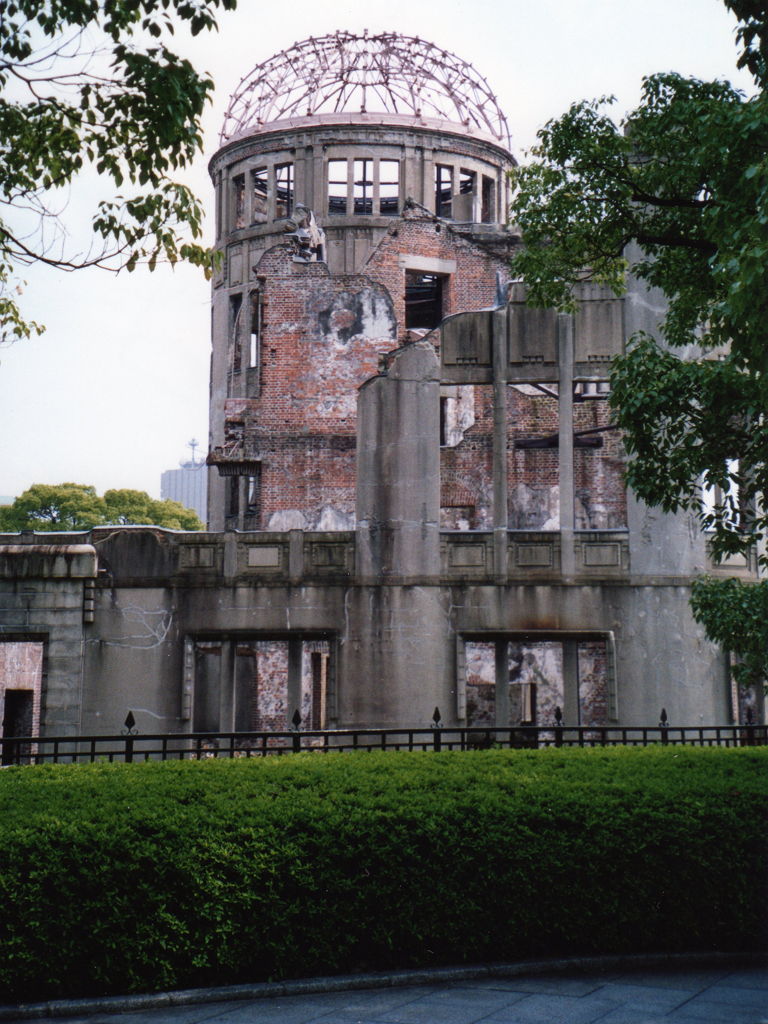
We finished our lunch and took a bus from the station to the Peace Museum park, the location of the Hiroshima Peace Memorial Museum. One of the first things that visitors see when they get off the bus is the A-bomb dome (genbaku dome). The dome is the remainder of a building located almost directly underneath the detonation site of the atomic bomb dropped on Hiroshima on August 6, 1945. Many people are not aware that the bomb actually detonated in the air over the city in order to cause more damage. The dome is the first sign that you are about to embark on an important, but not very fun learning experience.
Around the park you can find various monuments and statues dedicated to victims of the Hiroshima bombing. There are monuments for students, citizens, and even foreign labourers that died during or after the bombing. Since it was incredibly hot during the day, we didn’t spend a lot of time outside with the monuments, but instead headed for the Peace Museum.
The Peace Museum is one of the most interesting and depressing places I have ever been to. The museum starts with information about Hiroshima before the bombing, including maps, pictures and other displays. After setting the stage, you move onto information about the bombing itself, and it’s effect on the city and citizens.
I won’t spend time describing all of the exhibits in the museum, because I don’t have the ability to do them justice. However, I will describe two things that stood out for me. The first is a section of doorway from a building in Hiroshima. There was a person standing there when the bomb detonated, and you can see the shadow permanently burned into the concrete.
The second thing that stood out for me was the silence. In the first section of the museum (pre bombing Hiroshima), guests are walking around and talking to each other. Once people enter the post bombing area, nobody talks anymore.
The last area of the museum has information about the current state of nuclear weapons in the world, and copies of letters from the mayors of Hiroshima and Nagasaki to countries who perform nuclear weapon tests.
The Peace Museum is probably one of the most important places a person can ever go to in their life. The museum doesn’t debate Japan’s role in World War 2 or America’s decision to use the atomic bomb, but it does present information about the real and lasting effect that the bombing had on the city of Hiroshima and the people who lived there.
The museum absolutely affected me to the core of my being, and I will never forget the experience.
(2014 update) I decided to include the story about lunch along with the story of my visit to the museum because the lunch story still makes me smile. After revisiting my memories of the museum, I needed a smile.
July 1, 2004 – Hungry translator
Posted by Barniferous in Tokyo, Visitors on July 21, 2014
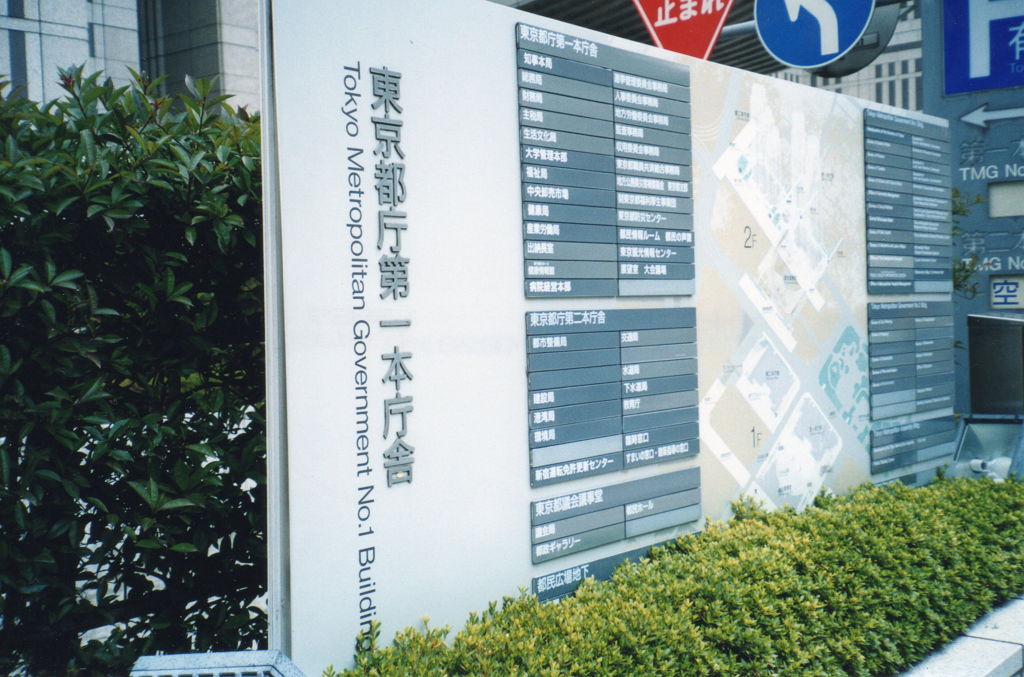
Directory at the Tokyo Metropolitan Government Building
Today we went to Shinjuku for sightseeing and to activate my family’s JR rail passes.
The JR Rail pass is a must purchase for visitors to Japan that will be doing a lot of traveling. Passes are available in 7, 14, and 21 day versions. They allow free transportation on all JR trains, all local JR busses, the Narita Express, and all except the fastest shinkansen. You need to purchase the pass before you travel to Japan, and then activate it when you arrive. The time period starts as soon as you activate the pass. Unfortunately the JR Rail Pass is not available for foreign residents of Japan, only visitors.
The closest place to Noborito to activate the JR rail pass was in Shinjuku. We boarded the Odakyu line and took the 20 minute ride into Shinjuku station. The plan was to quickly activate the passes, get lunch, and then explore Shinjuku for the afternoon.
It took us a while to actually find the travel office where we could activate the rail passes, and when we arrived we found a huge line of people ahead of us. By this point I was already hungry and looking forward to lunch. After waiting for about half an hour, we were at the front of the line. I asked my parents if they could take care of the passes themselves while I got something to eat. They were worried about doing something wrong or needing to speak Japanese, so I had to stay.
By the time the rail passes had been exchanged, I was ravenous. The staff at the travel office spoke English very well, which was good because I am pretty useless when hungry, and the Japanese language part of my brain had shut down. I declined their offer of help to book a hotel in Kyoto so we could leave sooner. Just before 2:00pm my family walked out of the travel office with active rail passes and one grumpy translator. Eventually we found a nearby Becker’s Burgers in the underground mall and I proceeded to stuff myself.
Now that I was fed and feeling like a human again, we left the sprawling Shinjuku station and started to explore the area. I walked my family down the main streets, near all of the restaurants, stores and pachinko parlours. I took them through the NS building and showed them the world’s largest water clock, which was the first landmark that I had seen when I arrived in Japan in September. In addition, we went to the Tokyo Metropolitan Government Building.

The government building, also known as Tokyo City Hall, has two large towers on each side of a central structure. Each tower has a free observation level on the 45th floor that provide breathtaking views of the Greater Tokyo Area. On a day with no clouds and minimal smog you can see Mt. Fuji. We had no such luck.
After completely overwhelming my family with tall building after tall building, we returned to Noborito to get packed for our 3 day excursion to Hiroshima, Kyoto, and Numazu. We all tried to watch a DVD in my room, but everyone was still jetlagged from the travel and we all had an early night.
(2014 Update) The JR travel offices that can be found in major train stations and airports are fantastic. They are happy to help you make your travel and hotel plans, and they can provide maps and recommendations for places to see. The best part is that they can do all of these things in English. Just make sure you get some lunch first – the lines can be long!
 Drinking in Japan
Recent Comments