Archive for category Western Japan
July 3, 2004 pt2 – Pulling rank
Posted by Barniferous in Shenanigans, Visitors, Western Japan on July 28, 2014
Other than the amazing sightseeing, my personal highlight from my day exploring Kyoto with my family occurred as we were ready to leave Kinkakuji. It involves a conversation between an American soldier and my sister.
There are about 50,000 American military personnel stationed in Japan. This is due to a treaty signed with Japan at the end of World War 2. The United States has pledged to defend Japan in cooperation with the Japanese Self Defense Force. Due to the large numbers of servicemen, it’s not uncommon to encounter them especially in popular tourist areas.
There were a small group of American soldiers in civilian clothes doing some sightseeing. While we were taking a short break before returning to the hotel, one of the soldiers started chatting up my sister. She seemed to enjoy the attention of the nice looking young man.
At some point my dad walked over, which forced my sister to awkwardly introduce him. The young man shook my dad’s hand politely. Then my sister mentioned that my dad was a retired Captain in the Canadian Forces. Instantly the young American snapped to attention, standing straight and tall. My dad tried to engage him in some small talk, and the soldier started responding with “yes sir” and “no sir”. He seemed to be intimidated by my very non threatening father. My sister was not amused at all.
Shortly after the soldier excused himself to rejoin his friends. My sister was annoyed, my dad didn’t understand why, and I stood off to the side laughing. Good times!
(2014 Update) My dad could have been a Major, but turned down a promotion so we didn’t have to move while I was in the middle of high school and my sister was in the middle of junior high school. If the young American soldier reacted so strongly to a Captain, I would have loved to see his reaction to a Major!
July 3, 2004 pt1 – Wabi sabi – Kyoto style
Posted by Barniferous in Visitors, Western Japan on July 27, 2014
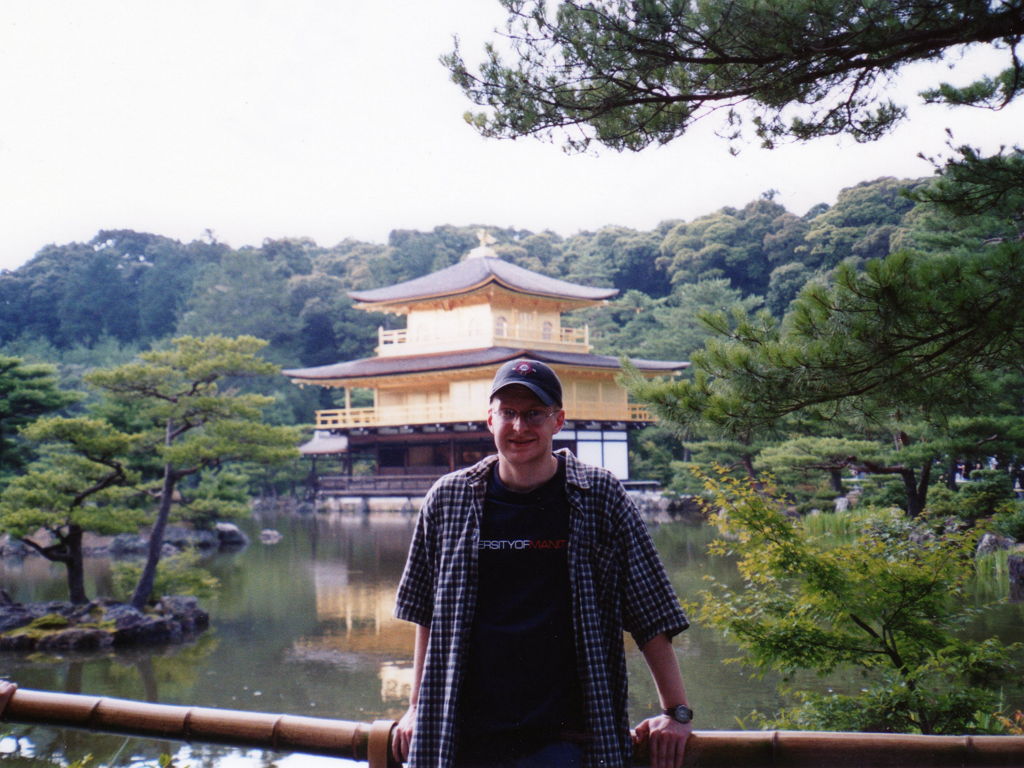
Me at Kinkakuji. Please note the Winnipeg Jets hat and the University of Manitoba shirt.
My family and I spent the day exploring parts of Kyoto, which was the capital of Japan until 1868. Kyoto is home to some of the oldest and most famous historical buildings in Japan, making it a very popular destination for tourists. All of the main tourist areas offer service and signs in multiple languages. Getting around is easy, with a small subway system and very well labelled buses. Tourist maps are available showing the location of all of the major tourist sites.
On our day in Kyoto, we went to three places: Nijo Castle, Daitokuji and Kinkakuji.
Nijo Castle in central Kyoto was our first destination. I love castles, so I made it a point to get Nijo on our itinerary for the day. Nijo is not the typical giant stone building that looks out over the land. It is a series of one story structures connected together, surrounded by beautiful grounds and a moat. My favourite feature of the castle was the nightingale floors – floors designed to squeak at the slightest touch. These floors were installed as a security feature so you could hear people coming.
From Nijo Castle, we went to north Kyoto to see Daitokuji – a large temple complex with several sub temples. I can’t remember the names of the places we went within the Daitokuji complex, but we did see a traditional zen garden with combed rocks. It was very relaxing.
Our main event of the day was Kinkakuji, the golden pavilion. Kinkakuji is by far the most popular tourist spot in Kyoto for foreign visitors. It is a Buddhist temple on a lake covered in gold leaf. The golden shine is striking, and easily visible from a distance. The original temple was founded in 1397, after being converted from a wealthy businessman’s villa. It was destroyed in the mid 1400s during the Onin war and rebuilt. In 1950, the temple was burned to the ground by a mentally ill monk. The current structure dates from 1955.
While foreign visitors love Kinkakuji, most Japanese people prefer the similarly named Ginkakuji, the silver pavilion. The name is deceptive – the original plan was to cover the structure with silver foil similar to the gold foil covering on Kinkakuji, but the covering was never finished. The difference in preference between the two temples illustrates the Japanese concept of “wabi-sabi”, which is a concept nearly impossible to translate fully into English. The best explanation of wabi-sabi that I ever heard was from The Penpal: a new stone carving is beautiful, but Japanese people think it’s more beautiful if it has been exposed to the elements for years and has some cracks.
It’s interesting to me that a country that strives for perfection in nearly everything also values the beauty in imperfections. I have learned a lot about Japan and it’s culture, but I don’t think I can ever truly understand everything. I can appreciate a peaceful rock garden however; they are the best.
July 2, 2004 pt3 – Where is the f**king hotel?
Posted by Barniferous in Visitors, Western Japan on July 24, 2014
My family and I started July 2 in Kawasaki, then traveled to Hiroshima and visited the Peace Memorial Park. The third and final stage of our long day of travel was returning to Kyoto and checking into a hotel.
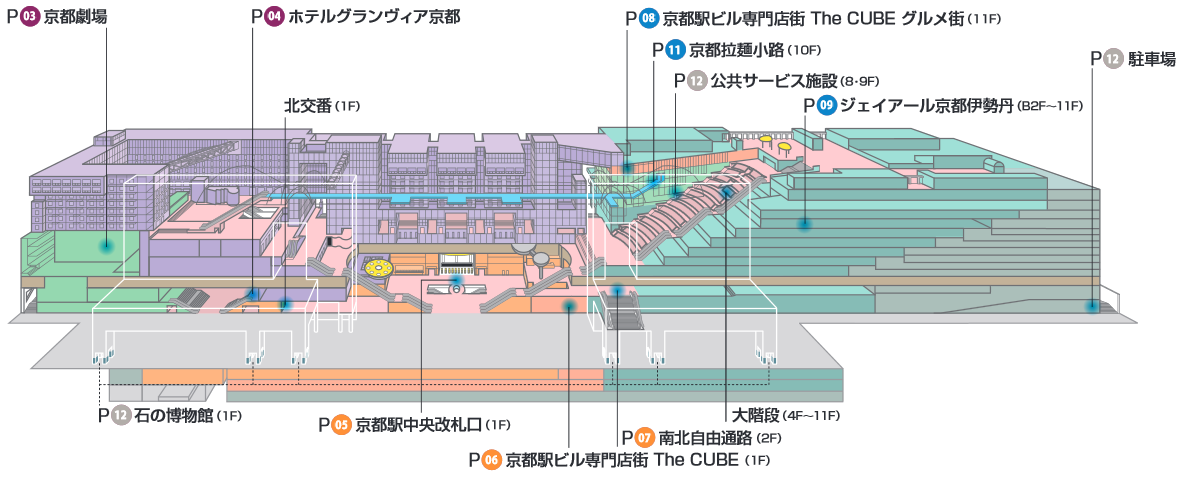
From Hiroshima we took the shinkansen to Kyoto station. Yesterday I made an online reservation at the Dai-Ni Tower Hotel in Kyoto, which was described as “just in front of JR Kyoto station”. The only problem was that Kyoto station is HUGE. The station itself is Japan’s second largest station building. In addition to having train service on JR, private train companies, and Kyoto subway, the station also features a shopping mall, movie theatre, and government services. If you need to do anything other than sightseeing in Kyoto, chances are good that you can find it at Kyoto station.
We got off the train with our bags, and then tried to find an area map. The station was so huge that the map was not helpful at all. I decided it was time to test out my Japanese ability and ask for directions. I found a nearby station information booth, approached it and asked the friendly attendant how to find the Dai-Ni Tower hotel.
Asking “where is blabla” is one of the first things people learn in a new language. In Japanese, it is very simple: “blabla wa doko desu ka?”, where blabla is the person, place, or thing you wish to know the location of. The difficult part is understanding the answer.
The helpful attendant looked relieved that I could speak some Japanese, and then proceeded to give me 5 minutes of detailed instructions at high speed. I got him to repeat the instructions, and tried to follow along with language and hand gestures. The directions were as follows:
- Walk to the end of the station
- Turn left
- Walk half way through a bunch of restaurants and stores
- Turn left
- Walk half way down another long hallway
- Go down some stairs
- Walk underground for a while, taking a slight right
- Go up some stairs
- ????
- There’s the hotel
We did pretty well following the instructions until the last part. We left the underground area at the wrong exit, and ended up at the back of Kyoto station with no Dai-Ni Tower hotel in sight. After unsuccessfully trying to find an area map, I got my family to wait nearby with the luggage while I tried to find someone else to get directions from. After a search, I ended up learning that the hotel was very close to where my family was sitting.
I returned to find my sister in a hilarious conversation with some drunk businessmen. They were trying (very poorly) to flirt with her in English by talking about how her gaijin nose was so nice and their Japanese noses were very flat. She declined an offer to go for a drink, and we were on our way.
At the hotel we learned that the online reservation didn’t work, but the hotel quickly found us rooms at the online rate using excellent English. We got our room keys and rode a tiny elevator up to our rooms.
I can’t speak for people from other parts of the world, but North Americans are always shocked by the size of Japanese hotel rooms. My parents had their own room, and my sister and I shared a room. If we could have knocked out the wall between the two rooms it would have been about the size of a typical Canadian hotel room. It was small, but at least we found the f**king hotel.
(2014 Update) Despite our difficulty in finding it, I would recommend the Dai-Ni Tower Hotel. It is located close to the station, is clean, quiet, and reasonably priced. Look it up on your favourite map website first, or make good use of any mobile device with GPS. Also, travel light: the only thing less fun than being lost is being lost while transporting large bags. Travel light!
July 2, 2004 pt2 – Hiroshima Peace Memorial Park
Posted by Barniferous in Visitors, Western Japan on July 23, 2014
After spending the morning traveling from Kawasaki to Hiroshima at high speed, my family and I were looking for some food. It’s always a safe bet to find inexpensive and quick food at major train stations. We quickly found a small restaurant with a display of plastic food outside that looked good. When we went inside, the menus were all text with no pictures. Most of the characters were beyond my Japanese ability. The nice waitress, likely familiar with foreign tourists, took us outside the restaurant to look at the food models so we could order.
When it was my turn to order, I told the waitress in Japanese that I would like the una-don, which is grilled eel on rice. Not sure if I knew what I was ordering, the waitress responded with “unagi wa… eigo de… this is eel”. I responded in Japanese telling her that I loved eel. When our food arrived, my rice had a huge piece of eel on top. I love Japanese service!
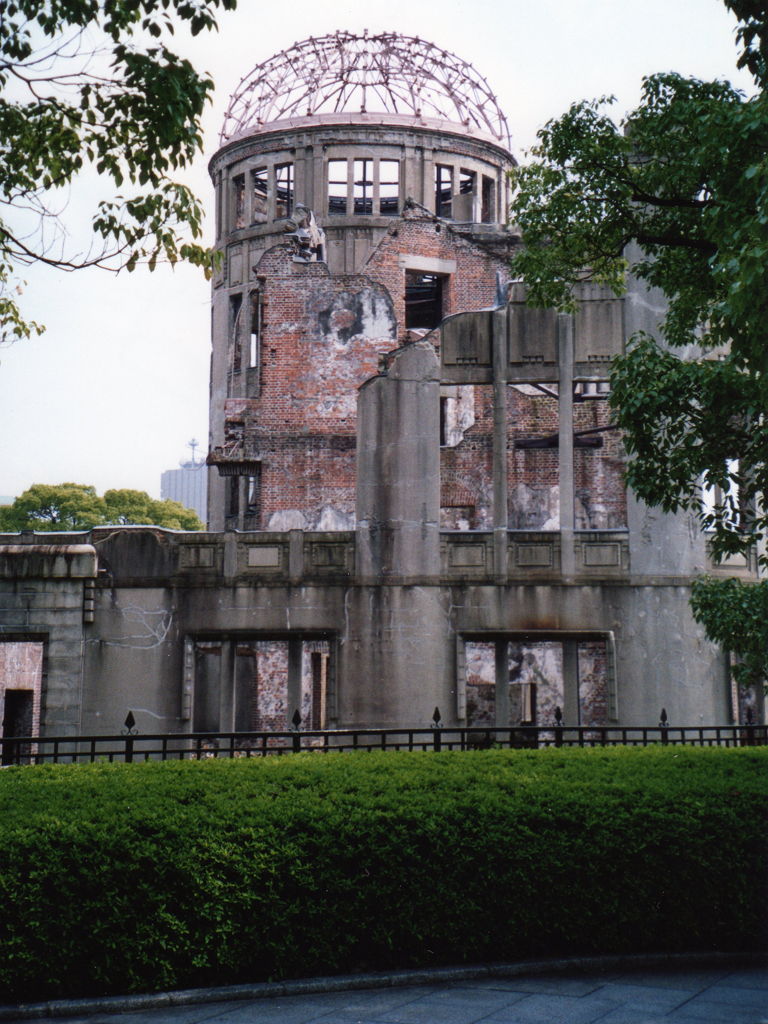
We finished our lunch and took a bus from the station to the Peace Museum park, the location of the Hiroshima Peace Memorial Museum. One of the first things that visitors see when they get off the bus is the A-bomb dome (genbaku dome). The dome is the remainder of a building located almost directly underneath the detonation site of the atomic bomb dropped on Hiroshima on August 6, 1945. Many people are not aware that the bomb actually detonated in the air over the city in order to cause more damage. The dome is the first sign that you are about to embark on an important, but not very fun learning experience.
Around the park you can find various monuments and statues dedicated to victims of the Hiroshima bombing. There are monuments for students, citizens, and even foreign labourers that died during or after the bombing. Since it was incredibly hot during the day, we didn’t spend a lot of time outside with the monuments, but instead headed for the Peace Museum.
The Peace Museum is one of the most interesting and depressing places I have ever been to. The museum starts with information about Hiroshima before the bombing, including maps, pictures and other displays. After setting the stage, you move onto information about the bombing itself, and it’s effect on the city and citizens.
I won’t spend time describing all of the exhibits in the museum, because I don’t have the ability to do them justice. However, I will describe two things that stood out for me. The first is a section of doorway from a building in Hiroshima. There was a person standing there when the bomb detonated, and you can see the shadow permanently burned into the concrete.
The second thing that stood out for me was the silence. In the first section of the museum (pre bombing Hiroshima), guests are walking around and talking to each other. Once people enter the post bombing area, nobody talks anymore.
The last area of the museum has information about the current state of nuclear weapons in the world, and copies of letters from the mayors of Hiroshima and Nagasaki to countries who perform nuclear weapon tests.
The Peace Museum is probably one of the most important places a person can ever go to in their life. The museum doesn’t debate Japan’s role in World War 2 or America’s decision to use the atomic bomb, but it does present information about the real and lasting effect that the bombing had on the city of Hiroshima and the people who lived there.
The museum absolutely affected me to the core of my being, and I will never forget the experience.
(2014 update) I decided to include the story about lunch along with the story of my visit to the museum because the lunch story still makes me smile. After revisiting my memories of the museum, I needed a smile.
 Drinking in Japan
Recent Comments