Posts Tagged language barrier

August 14, 2004 – Adventures at the lost and found

Today I didn’t have to teach any kids, I got a double voice class, and an empty lesson at the end of the day. This way by all measures a good day at work.

During the shift I was chatting with Maria. I tried to help her a lot when she first became a teacher, and we got along very well at work. In the four months since she started she had become very comfortable in the classroom, and had an active social life outside of work.

While chatting, she told me that she had left her bag on a train. Japan Rail told her she could pick up her bag at the lost and found in Noborito station. I told her that Noborito was my home station, and offered to take her there and help her get her bag back.

Maria is a very outgoing and friendly person who is not shy at all. Half way to Noborito she pulled out her phone and told me to check out some of the pictures she had taken with her phone’s camera. I looked at the phone and was very surprised to find myself looking at pictures Maria had taken of herself in the shower. Naked.

While my brain was trying to process what was happening, Maria told me that she was very proud of how she looked, considering she was in her mid 40’s. I think I squeaked out a sound of agreement. She was also proud of her skills as a photographer, happy that she was able to take such good pictures of herself with the tiny camera in the cell phone. I probably squeaked out some other sound of agreement. She then took her phone back, and changed the subject like nothing ever happened.

When we got to Noborito station, Maria tried to use her very limited Japanese to claim her bag back at lost and found. The middle aged JR staffer we talked to spoke no English at all, but Maria kept trying her best and smiling. The JR employee gave her a claim receipt and I helped her fill it out. She returned to the counter with the completed form, and tried to ask if the form was okay.

Her first attempt involved pointing at the form and asking “genki?” which means healthy. The employee looked confused. She then pointed at the form and asked “watashi suki?” which roughly means “do you like me?”. He seemed more confused. Her third attempt involved pointing at the form and saying “sugoi?” which means “great?”. Same reaction. Finally she remembered the word “daijoubu” which means “ok”. He nodded and retrieved Maria’s bag. When he handed it over, she gave him a perfect “domo arigato gozaimasu” (thank you very much). He and I both burst out laughing.

Being friends with Maria was always interesting!

(2014 Update) I omitted the nude selfies in the original post, both because I worked with “Maria” and because I had a girlfriend who read my blog. I assure you that this actually truly happened! A few days later I saw her showing off the pictures in the teachers room to a very surprised male coworker. I don’t think she was trying to hit on anybody, I think she was just legitimately proud of how she looked. If I look that good (in a manly way) in my mid 40’s, I will be proud too!

(2014 Update 2) I apologize to anyone who was searching for nude selfies and found this story instead. I hope you enjoyed it, and suggest you will have better luck finding pictures on Tumblr. Or Google. Or one million other websites.

, , ,

Leave a comment

July 5, 2004 pt2 – Pachinko and passports

In Kyoto, my father and I went out for sushi and beer while my sister and mother went to McDonalds. By request, my mother wanted to spend the evening with me, leaving my sister and father to have their own adventure.

My mom and I went out for dinner near Mukogaokayuen station. I tried to be a good tour guide, showing off the neighbourhood. We talked about my time in Japan so far and my job, and also caught up on things that were happening back at home.

After dinner my mom wanted to try pachinko. I had played came centre “fun” pachinko before, but had never tried the real thing. No matter where you go in Japan, you are never very far from a pachinko parlour. We easily found one and sat down.

Neither one of us knew what do to with the machine, but a friendly man next to us showed us where to put the money and what to do. We fed in some money, turned the lever and watched as a stream of little silver balls bounced through the machine. In case that wasn’t distracting enough, there were also lights and a video screen. It was total sensory overload, but we really didn’t get into it too much. It was a good experiment for 1000 yen each.

We walked back to Hello House, wondering how my father and sister did with their evening out. When we saw them, they were excited to tell the story.

The two of them went to a restaurant near the station and sat down at a table. The restaurant was one of the convenient places near a station with at ticket machine outside. To order, you insert money, press the button for the food you want, and then enter the restaurant and give the ticket to the waitress. The waitress noticed they didn’t have tickets, and took them outside to the machine. My dad and sister pointed at the food models that they wanted, and the waitress pressed the correct buttons on the ticket machine.

They had a good dinner and conversation, and then got up to leave and walk around the Noborito station area. As they started walking down the street, they heard someone yelling from behind. It was the waitress from the restaurant, running after them with my sister’s purse. With all the excitement about dinner, my sister had left her purse with her money and passport at the table. My sister showed the waitress that the passport was inside, and then offered thanks in English and Japanese.

In some other countries, the waitress wouldn’t have made the effort to help the foreigners who couldn’t speak the local language to order food. And in other countries, the purse would have either sat in the lost and found or “disappeared”. Japan is not other countries. In my short time in the country, I have seen countless examples of staff going above and beyond to provide great service. Thank you, station restaurant waitress! You helped make our evening memorable in a good way.

(2014 Update) My mom and I needed this site, which explains in (sort of) English how to play pachinko.

, , ,

2 Comments

July 5, 2004 pt1 – We can’t go to Daiei anymore

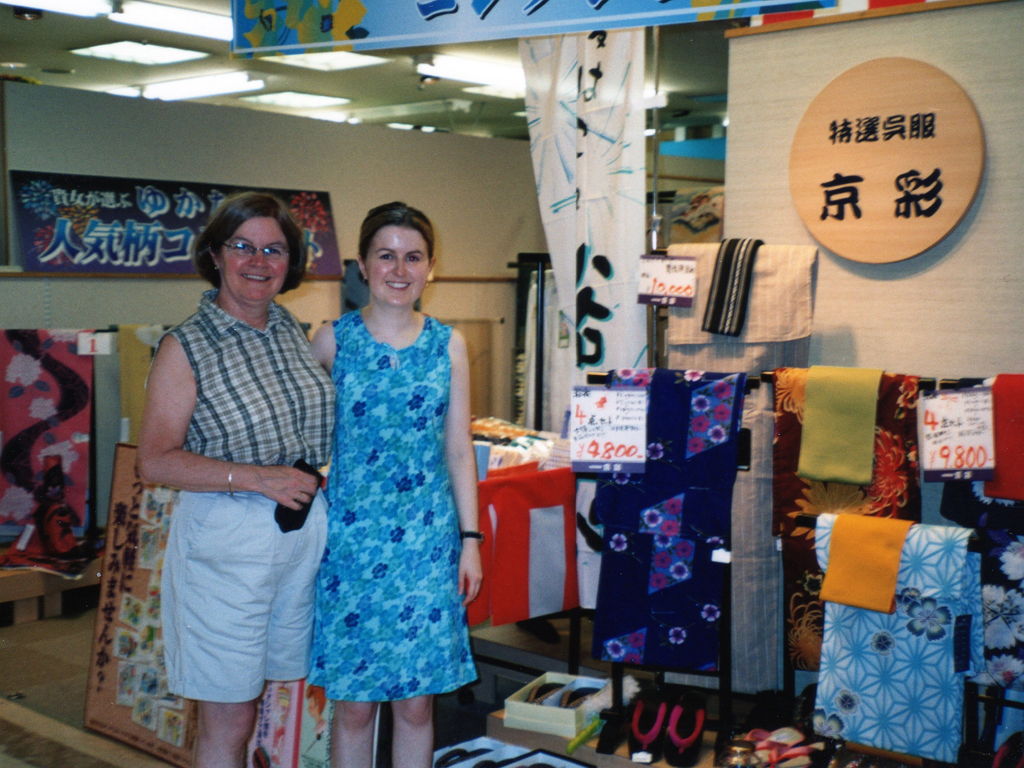
My mother and sister in the kimono section of Daiei

My mother and sister in the kimono section of Daiei

After a few grueling days of traveling, my family decided that they wanted to take a day off and stay close to Hello House. I got a chance to catch up on some relaxing and video games, but my sister wanted to do some exploring.

The week before, I gave her directions to the Daiei department store near Mukogaokayuen station, which was only a 5 minute walk from Hello House. She returned after buying herself a Hello Kitty watch, feeling quite proud of herself because she didn’t get lost.

Today she went to Daiei again by herself. She came back an hour later looking distressed and said “we can’t go to Daiei anymore”. I asked her to explain.

It seems that she went to look at the kimono and yukata section of the store. The sales people came over to help, and before she knew it, she was trying on different fabrics, belts and accessories. “I looked like a princess” she told me, while trying to get through the story.

After trying on several combinations of clothing, the sales people started packing up everything and taking it to the cash register. My sister, who just went to look, had no ability to explain that she was not actually interested in buying. She somehow managed to communicate to the store staff that she didn’t have any money, but her dad would come back to pay for everything. When the message got through, she left the store and returned to Hello House.

Having been in a few awkward situations without the ability to communicate, I could completely understand her feelings. I tried my best not to laugh, and promised that we wouldn’t go back to Daiei before my family returned to Canada.

To the staff at Daiei, please accept our apologies for the confusion. Also, thanks for making my sister look like a princess, even for a few minutes.


, , , ,

1 Comment

July 2, 2004 pt3 – Where is the f**king hotel?

Kyoto station

My family and I started July 2 in Kawasaki, then traveled to Hiroshima and visited the Peace Memorial Park. The third and final stage of our long day of travel was returning to Kyoto and checking into a hotel.

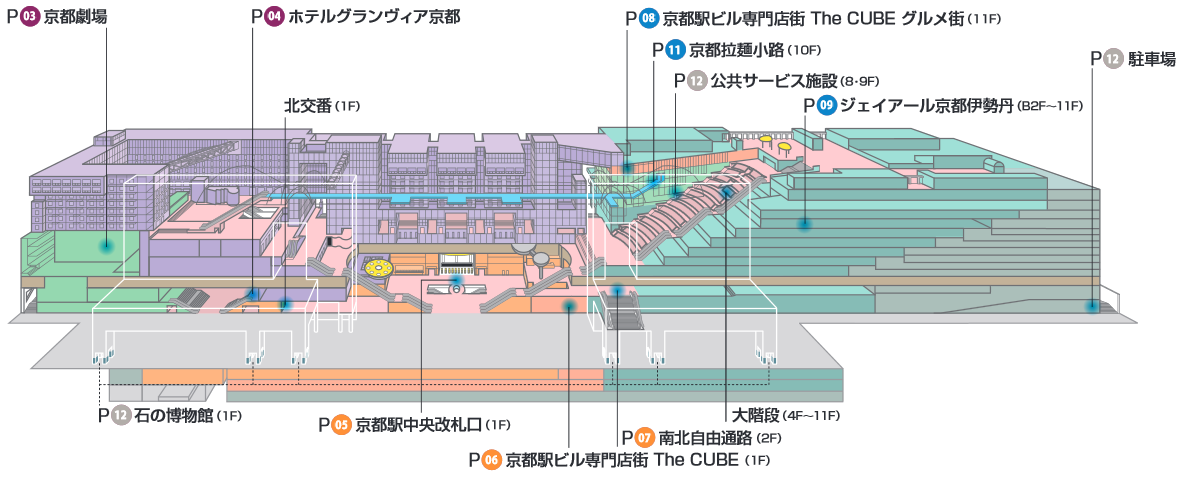
From Hiroshima we took the shinkansen to Kyoto station. Yesterday I made an online reservation at the Dai-Ni Tower Hotel in Kyoto, which was described as “just in front of JR Kyoto station”. The only problem was that Kyoto station is HUGE. The station itself is Japan’s second largest station building. In addition to having train service on JR, private train companies, and Kyoto subway, the station also features a shopping mall, movie theatre, and government services. If you need to do anything other than sightseeing in Kyoto, chances are good that you can find it at Kyoto station.

We got off the train with our bags, and then tried to find an area map. The station was so huge that the map was not helpful at all. I decided it was time to test out my Japanese ability and ask for directions. I found a nearby station information booth, approached it and asked the friendly attendant how to find the Dai-Ni Tower hotel.

Asking “where is blabla” is one of the first things people learn in a new language. In Japanese, it is very simple: “blabla wa doko desu ka?”, where blabla is the person, place, or thing you wish to know the location of. The difficult part is understanding the answer.

The helpful attendant looked relieved that I could speak some Japanese, and then proceeded to give me 5 minutes of detailed instructions at high speed. I got him to repeat the instructions, and tried to follow along with language and hand gestures. The directions were as follows:

  1. Walk to the end of the station
  2. Turn left
  3. Walk half way through a bunch of restaurants and stores
  4. Turn left
  5. Walk half way down another long hallway
  6. Go down some stairs
  7. Walk underground for a while, taking a slight right
  8. Go up some stairs
  9. ????
  10. There’s the hotel

We did pretty well following the instructions until the last part. We left the underground area at the wrong exit, and ended up at the back of Kyoto station with no Dai-Ni Tower hotel in sight. After unsuccessfully trying to find an area map, I got my family to wait nearby with the luggage while I tried to find someone else to get directions from. After a search, I ended up learning that the hotel was very close to where my family was sitting.

I returned to find my sister in a hilarious conversation with some drunk businessmen. They were trying (very poorly) to flirt with her in English by talking about how her gaijin nose was so nice and their Japanese noses were very flat. She declined an offer to go for a drink, and we were on our way.

At the hotel we learned that the online reservation didn’t work, but the hotel quickly found us rooms at the online rate using excellent English. We got our room keys and rode a tiny elevator up to our rooms.

I can’t speak for people from other parts of the world, but North Americans are always shocked by the size of Japanese hotel rooms. My parents had their own room, and my sister and I shared a room. If we could have knocked out the wall between the two rooms it would have been about the size of a typical Canadian hotel room. It was small, but at least we found the f**king hotel.

(2014 Update) Despite our difficulty in finding it, I would recommend the Dai-Ni Tower Hotel. It is located close to the station, is clean, quiet, and reasonably priced. Look it up on your favourite map website first, or make good use of any mobile device with GPS. Also, travel light: the only thing less fun than being lost is being lost while transporting large bags. Travel light!

, , , ,

2 Comments

March 18, 2004 – Renting a movie is challenging

I recently purchased a Playstation 2 in order to save money. The idea was that if I could watch movies and play games at Hello House, I would be less likely to go out and spend money on the many fun things available in the greater Tokyo area.

After work I went to a nearby small video rental shop to rent a DVD. Using a combination of my bad Japanese and the clerk’s awful English I was able to get a membership and rent 28 Days Later. Getting a membership was tricky, but renting movies is also challenging. All of the movies are sorted in Japanese hiragana order; a, i, u, e, o, ka, ki, ku, ke, ko, etc. To find a movie you need to figure out what the name is in Japanese and look there. For example, Star Wars is written as スター・ウォーズ (sutaa uooz), so you need to look in the “SU” section. This is assuming that the Japanese movie name is the same as the English title.

When renting movies that are not in English, you need to be able to interpret which audio languages and subtitles are available. I love Jackie Chan movies, but most of the copies available were in Cantonese with Japanese subtitles.

Having a Playstation also allows me to play video games. However, since the games are available in Japanese only I need to have a dictionary nearby for any of the important dialogue. It is great language practice, but some games can be a lot of work.

Despite the challenges, I love my Playstation and 28 Days Later kicked ass.

, , , , ,

3 Comments

February 18, 2004 – Haircut in a foreign language

What a productive day! I slept late, picked up my dry cleaning, got pictures developed, got my hair cut, watched an hour of Simpsons, cleaned my room and washed my dishes immediately after using them (for a change).

(2014 update)

Upon preparing this entry for publishing 10 years later, I notice that I have not yet explained the terrifying experience of getting your hair cut in a foreign language. It is something definitely worth more than the few words that I used in my original post.

My hair is very annoying. It doesn’t grow long like most people, it just gets thick and poofy. While growing up I have had several people suggest that I grow and epic white guy fro, but that’s not going to happen. In order to prevent the fro, I usually need to get my hair cut every 4-6 weeks, with 8 weeks being the absolute maximum. I got my hair cut ridiculously short before leaving Canada, but a few months after arriving I was badly in need of a haircut.

I asked some of the guys in Hello House if they had any recommendations for a good place to get a haircut. Most people suggested a barber shop near Mukogaoka-yuen station, and I also got a few suggestions to buy my own clippers and just cut my own hair. Since I didn’t trust my ability to cut my own hair without turning my tatami mat into a hair carpet, I decided to test my Japanese skills at the barber shop.

At the barber shop there was exactly one person who spoke English – me. I got into the chair and was asked a question which I assume was “what kind of haircut would you like”. I had some instructions prepared, but forgot them all in the moment and managed to say “zenbu mijikai” (everything short) while making a confusing gesture around my head. The barber responded in Japanese by confirming that I wanted a really short haircut (probably). I agreed and proceeded to get a military quality buzz cut.

Having someone cut your hair when you can’t fully communicate is a scary experience. Having someone cut your hair when they have never before worked with hair the same colour or texture as yours is even scarier. As scary as this was for me, it was worse for women who can’t speak Japanese. Many of my female coworkers would go very long times between haircuts, and then would only get their hair done in a very expensive salon where someone could speak English.

I did get better at communicating with barbers over my time in Japan, but always got really short haircuts because it was the easiest thing to do. If you are planning on spending an extended time in Japan, plan ahead for your hair cutting needs.

, , , ,

2 Comments